Thursday, September 04, 2003

For Lack of Anything Better to Say . . . An Old Email

Dear _____,

I went for a drive tonight for a couple of reasons. For one, it was a beautiful dark-blue night -- like driving into the deep sea. The traffic was minimal, and the only thing I was missing was a destination. But, the more I thought about, do any of us ever know any of our destinations. Sure, we have our plans -- X marks the spot -- to go from point A to point B, perhaps indulging in circuitous scenic routes or nomadic fruit stands along the way, but the reality of life is that plans exist to fail.

In essence, when we plan to do something, we, by definition and often unconsciously, plan NOT to do some other set of alternative actions that would otherwise prevent what we would like to accomplish. This is all well and good, and I would think provides the impetus for most of the things that actually get done in life, but the shocking reality is that things rarely ever go as planned. Planes are generally either early or late. No two road trips ever takes exactly the same amount of time. The things that we often think are set in stone are perhaps only written in chalk.

The reason for this is simple: We interact on a nearly infinitesimal level with other people and their plans. Some of these plans coincide with ours, others don't; all of them, however, directly or indirectly, play a role in the development, promotion, or subversion of each of our plans. One decision may not appear to affect another, but on closer inspection -- that is, interestingly, by stepping back -- we see that most human circumstances are created by human decisions, or humans working toward a (unconscious or conscious, unintentional or intentional [whatever either of those words really mean]) plan.

It is not so much a puzzle, as this is far too static an image, as it is a bivouac of ants. When a colony of ants is on the march, they set up headquarters by forming a nest composed entirely of their own bodies. A few ants will anchor themselves by their legs to the bottom of a fallen tree. Other ants hook onto the first ones, then more, then more, until they begin to form long, wiggling brown ropes. As more and more ants join, the ropes merge into an enormous thicket. It may contain hundreds of thousands of individual ants. Inside are tunnels and chambers and galleries through which ants carry food, tend to the queen and her brood, and fuss with the endless chores of maintaining the bivouac.

The point of all this, simply enough, is to say that what looks like, from a distance, a single 'something' is actually a complex collection of 'somethings'! The same would appear to be true with human circumstances. Nothing we do is done is our own. We often make plans that are congruent with societal norms, norms that are constructed by a community's prevailing majority and not necessarily representative of an individual creation. Sometimes these societal norms are internal compulsions, other times they are external -- neither can be said to be any more or less malevolent because of where its compulsive power resides. Furthermore, the very actions in which we engage ourselves are connected with other plans on the outside that work against the success of our own. In sum, our plans are merely that -- ours. Yours are not mine; mine are not yours. In fact, your plans two weeks ago for tomorrow may not reflect your goals now for that same day. Therefore, not only are our plans 'ours,' but they are 'ours' only on the most banal (though necessary) of existential levels. That is, they are our plans in-the-now, if such a time can rightfully be said to exist -- the moment you appeal to it, it is has passed.

Plans are perhaps not things to which we appeal, as we attempt to give our life its parameters or its shape, but simply the product of lives lived in response to the free-floating, surface-level chaos that comprise the matrix of the human condition. Should we plan? I think so: To live is to plan, for all human decisions necessitate a plan of action -- do this, don't do this; to plan is to (often) fail; to fail is to live (and learn, so the maxim goes). And so the cycle goes. To not plan doesn't avoid the 'problem,' if you want to call it that. It, in fact, shows how wed we are to its reality, because it itself is a plan of action. One, I hasten to add, we have already failed to achieve.

To conclude, I said I had couple of reasons for my drive this evening, but the most important was that I was hungry.

Love,

Brad

Tuesday, August 26, 2003

A Dedication

The Death Bong

(For my long-suffering hosts.)

Monday, August 25, 2003

Oh Yeah

I don't remember mentioning this in any of my previous posts, but on Saturday I flew back to the Heartland of America. To my fellow Americans, I have come bearing gifts -- that of dark chocolate and fine Trappist ales from Belgium (sadly, there was one beer casualty whilst travelling, rendering one piece of luggage a stinky mess), not to mention some delicious uisge beatha To those Europeans I've left for five weeks, I promise to return with a revived level of snarky, blame-America-first scorn ('cause, you know, that's what we lefties do). As for now . . . I'm truly enjoying central air conditioning.

Something Light to Start Off Your Day

Okay, maybe not. I saw a little blurb on Indianapolis' Fox affiliate last night -- their 10:00 news, by the way, is something beyond awful (I take back all the awful things I've thought about the BBC) -- about somebody dying during a prayer meeting, and this actually seemed darkly humorous at the time, but the story behind the blurb is unspeakably, heartbreakingly sad.

UPDATE: It's official now: it was a homicide.

Saturday, August 16, 2003

Out of Commission

Just to let everybody know, due to the wild world of a virus-infected computer, I've been out of blogging commission since Wednesday, and will continue to be, for the most part, throughout next week. I truly hate blogging at Katrien's place in Voorshoven anyway, so maybe it's for the better.

Sunday, August 10, 2003

It's a bird, it's a plane.... no, wait, it's just a bird

You Want A Piece o' Me?

Masters of intimidation, they stalk their victims relentlessly and without mercy. Now they are bringing their menace to Britain's town and cities and have been blamed for a string of brutal attacks on urban dwellers this summer.

The arrival of vast numbers of seagulls has created a sharp upsurge in reported incidents. Most major urban areas have experienced attacks, including London, Birmingham and Glasgow.

[. . .]

Councils throughout the UK are drawing up plans to tackle the menace. Calls for mass gull culls are growing. Shooting, poisoning or egg-destroying have been discussed by exasperated officials.

It follows a series of attacks, whose victims have included a woman who sustained deep beak wounds to her head, a pet dog pecked to death and a Welsh pensioner, who had a fatal heart attack after she was swooped on by the birds.

One Sussex school recently had to postpone lessons and install netting above the playground to protect pupils following the attentions of an agitated seagull. Another recent victim was pensioner Marie Munro, who was attacked and put in hospital after weeks of intimidation by the same seagull, an attack that shares parallels with Alfred Hitchcock's 1963 thriller The Birds.

Munro recalls being constantly followed around by the gull for hundreds of yards. However, it was when she set off her personal alarm in a desperate attempt to frighten her stalker away that the intimidation turned ugly. 'That was a big mistake. Every time I stepped a foot outside it would follow me overhead, occasionally dive-bombing me,' she said.

Then the seagull began trailing her husband Len. The next phase of attack entailed attacking the pair in their back garden. Then last month came the attack that sent her to hospital for treatment.

As the creature dived for her face, Munro staggered back and fell, splitting the bone down the length of her foot and rupturing her tendons. Yesterday the plaster came off, but the terror remains. 'They are spreading farther afield. They are just so aggressive and intelligent with it,' she warns.

[. . .]

[Peter] Rock, a visiting fellow at Bristol University, said: 'Urban gulls are increasing exponentially. Many reports suggest they are terrorising workers and even striking bystanders on the street. They also produce large amounts of excrement, some deliberately aimed at humans.' (my emphasis)

Heads up!

Journalistic Dissonance

It's Choose-Your-Own-Adventure Day in today's Washington Post.

First, there's Option A:

This article is based on interviews with analysts and policymakers inside and outside the U.S. government, and access to internal documents and technical evidence not previously made public.

The new information indicates a pattern in which President Bush, Vice President Cheney and their subordinates -- in public and behind the scenes -- made allegations depicting Iraq's nuclear weapons program as more active, more certain and more imminent in its threat than the data they had would support. On occasion administration advocates withheld evidence that did not conform to their views. The White House seldom corrected misstatements or acknowledged loss of confidence in information upon which it had previously relied . . .

And then, Option B:

THE 2004 PRESIDENTIAL race seems to be carrying the Democratic Party in a dangerous direction on the issues of the Iraq war and national security -- dangerous for the nation and risky for the party too. Some of the candidates are more off course than others. If they listen to former vice president Al Gore, who took it upon himself last week to suggest a theme of attack for the nine candidates, they will all go off the cliff.

Mr. Gore, who not so long ago was describing Iraq as a "virulent threat in a class by itself," validated just about every conspiratorial theory of the antiwar left. President Bush, in distorting evidence about the Iraqi threat, was pursuing policies "designed to benefit friends and supporters." The war was waged "at least partly in order to ensure our continued access to oil." And it occurred because "false impressions" precluded the nation from conducting a serious debate before the war.

This notion -- that we were all somehow bamboozled into war -- is part of Mr. Gore's larger conviction that Mr. Bush has put one over on the nation, and not just with regard to Iraq.

[. . .]

He's not the only Democrat who thinks he can have it both ways, pandering to anti-Bush passion while protecting his national-security flank. Sen. John Kerry has been trying something similar with, for example, this applause line, which he must know can only stoke isolationist sentiment: "We shouldn't be opening firehouses in Baghdad while closing them in Brooklyn." It would be possible to support firefighters in Brooklyn without questioning U.S. commitment to Iraq. Sen. Joe Lieberman has found plenty to criticize in the Bush administration foreign policy without abandoning his longstanding support of American strength and democracy promotion. It's an honorable position, and one that doesn't depend on portraying everyone else as poor saps duped by wizardly Bush propaganda.

Unfortunately, unlike the series of old, you can't flip ahead to see which alternative leads you (or, as the case may be, the ascendency of an oil-addled junta) to an untimely end. Bugger.

Another Season

I don't think this has anything to do with it, but seeing it today made me think of another season of footie action here in Glasgow. Have at it, ye neighbourly, intoxicated yobs.

Thursday, August 07, 2003

It's a Life

Sorry for the lack of posts these latter days. Between meetings at the department and moving, I'm ready for this week to be over! Fortunately, I'm nearly moved into my new flat in Glasgow -- and so very close to having a decent cable provider to boot! After toiling for two years in relative squalor it's nice to have a bit more luxury in my life, even if most of that luxury is paid for with loans. Perhaps I should be like all the other cool bloggers and start asking for money?

Anyway, for those who are at all curious, this is what my street looks like:

I should say, though, that I don't actually know this to be Dumbarton Road, my new West End haunt, but there's something about every major street around here that looks utterly same. So, even if it's not, it may as well be my street.

Tuesday, August 05, 2003

A Dedication

This one's for Silentio's favourite regular reader -- she knows who she is. And if she doesn't, she'll know when she clicks the link. For everybody else, I can but say: 'The Dude abides.'

Sunday, August 03, 2003

What a Great Gig!

For proof that reading the smaller, slightly hidden articles in your Sunday paper is much more fulfilling than anything on the front page see page twenty-one of today's Observer, 'Delphic oracle was ancient glue-sniffer':

She advised generals about invasions; told citizens about the fates of their investments; and even warned Oedipus about the dangers of murdering his father and marrying his mother.

Yet the oracle at Delphi was not blessed with prophetic vision, scientists have discovered. In fact, she was high on alcoholic vapours.

This is the conclusion of scientists - writing in this month's Scientific American - who have found that the oracle chamber was built over a geological fault from which seeped ethane and ethylene gases. As a result, the oracle, the temple maiden who uttered Delphi's prophecies, was probably in a permanent narcotic state.

In other words, the oracle's utterings, upon which so much of ancient Greek life depended, were not the words of Apollo, the god of prophecy, but the babblings of a drunk or glue-sniffer.

Readers of Nietzsche, of course, already knew this, as Dionysus can never be too far from Apollo.

Friday, August 01, 2003

Foreign Policy

UPDATE: I don't necessarily object to the three words I've since deleted from this post, but posting them was a product of a double of Glenfiddich I probably should not have accepted. Being too forthright is always frowned upon here at Silentio, if not necessarily in real life -- even when there's whisky involved.

Unemployment versus No Employment

Good news, my unemployed friends! Our great nation's unemployment rate in July dipped to the laughably miniscule (or not!) 6.2%. Wonderful news! Beautiful day! No more beans and rice for breakfast, lunch, and dinner, the masses sing. Oh wait, you mean there's a difference between unemployment going down and number of places offering NO EMPLOYMENT going up?

The nation's unemployment rate declined to 6.2 percent in July as nearly half a million discouraged Americans stopped looking for a job. Payrolls were cut for the sixth month in a row, suggesting that businesses remain cautious and want to keep work forces leans despite budding signs of an economic revival.

The Labor Department's report Friday pained a picture of a job market that remains stubbornly sluggish and continues to frustrate people looking for work.

The economy lost 44,000 jobs in July. While that's an improvement from the 72,000 shed in June, economists were hoping that positions would actually be added. They were forecasting payrolls to go up by around 10,000.

Although the jobless rate dipped to a two-month low of 6.2 percent from a nine-year high of 6.4 percent in June, much of decline's July represented the exodus of 470,000 discouraged people who abandoned job searches because they believed no jobs were available.

Oh, lest ye Republicans worry about the reelection chances of your chosen son, we almost get yer weapons fer ya. Ahem, on second thought, or do we?

Wednesday, July 30, 2003

The Sex Lives of Linkers

If you're into the non-computer world of A-list bloggers, and gosh, who isn't(!), sneak a peek into the torrid sexual lives they lead. Via, once again, a favourite here at Silentio, Christopher Monks.

Outta da way, hoser

I think Canada can expect an immigration increase pretty soon, now that President Painfully Furrowed Brow has made it clear that he so dearly wants to make sure no homosexuals at all vote for him in 2004. Enflamed by her husband's lupine heterosexuality, and with the chemically-induced melange of eroticism and lust that only Mrs. George W. Bush (aka "Laura") can muster, the mind can but reel at the salacious rimming our Husband-in-Chief is due for tonight.

Oh yeah, to sorta quote the erotic Presidential poetry of Christopher Monks, tap 'dat exclusively female, within-the-confines-of-marriage ass, Mr. President. Tap Tap Tap 'dat ass.

Tuesday, July 29, 2003

America is a Religion

I was talking to Pat -- mi amigo y se alía de Aquadoodiloop -- on the phone the other night, lonely boy that I am, now that Katrien has fled back to Belgium for a few weeks. The topics were, as they normally are, too many to name and/or remember. However, one stands out to me, not least of which because it plays a role in my doctoral thesis: mythology, namely that of Nazi German (the topic began with my disquisition on the German Romantic's search for a new modern mythology, the ensuing, but by no means necessary, etiology of National Socialism in Germany, and the parallels, rough though they may be, with that of the American tradition. My line must've gotten crossed with George Monbiot's (it's British Telecom, so you never know), as he was explaining to the Guardian Commentary editor that he just didn't have any ideas for his Tuesday column:

The United States is no longer just a nation. It is now a religion. Its soldiers have entered Iraq to liberate its people not only from their dictator, their oil and their sovereignty, but also from their darkness. As George Bush told his troops on the day he announced victory: "Wherever you go, you carry a message of hope - a message that is ancient and ever new. In the words of the prophet Isaiah, 'To the captives, "come out," and to those in darkness, "be free".'"

So American soldiers are no longer merely terrestrial combatants; they have become missionaries. They are no longer simply killing enemies; they are casting out demons. The people who reconstructed the faces of Uday and Qusay Hussein carelessly forgot to restore the pair of little horns on each brow, but the understanding that these were opponents from a different realm was transmitted nonetheless. Like all those who send missionaries abroad, the high priests of America cannot conceive that the infidels might resist through their own free will; if they refuse to convert, it is the work of the devil, in his current guise as the former dictator of Iraq.

[. . .]

Since the attacks on New York, this notion of America the divine has been extended and refined. In December 2001, Rudy Giuliani, the mayor of that city, delivered his last mayoral speech in St Paul's Chapel, close to the site of the shattered twin towers. "All that matters," he claimed, "is that you embrace America and understand its ideals and what it's all about. Abraham Lincoln used to say that the test of your Americanism was ... how much you believed in America. Because we're like a religion really. A secular religion." The chapel in which he spoke had been consecrated not just by God, but by the fact that George Washington had once prayed there. It was, he said, now "sacred ground to people who feel what America is all about". The United States of America no longer needs to call upon God; it is God, and those who go abroad to spread the light do so in the name of a celestial domain. The flag has become as sacred as the Bible; the name of the nation as holy as the name of God. The presidency is turning into a priesthood.

So those who question George Bush's foreign policy are no longer merely critics; they are blasphemers, or "anti-Americans". Those foreign states which seek to change this policy are wasting their time: you can negotiate with politicians; you cannot negotiate with priests. The US has a divine mission, as Bush suggested in January: "to defend ... the hopes of all mankind", and woe betide those who hope for something other than the American way of life.

The dangers of national divinity scarcely require explanation. Japan went to war in the 1930s convinced, like George Bush, that it possessed a heaven-sent mission to "liberate" Asia and extend the realm of its divine imperium. It would, the fascist theoretician Kita Ikki predicted: "light the darkness of the entire world". Those who seek to drag heaven down to earth are destined only to engineer a hell. (my emphasis)

Monbiot's column is, shall we say, a little inflated and hyperbolic, but there's enough good stuff that it made me want to call Pat and continue our conversation.. Be ready, my friend.

C'mon, Mama, Rummy Needs a New Pair o' Shoes!

Ah... our friends over at the Pentagon's Defense Advance Research Projects Agency [DARPA]. home of course of the much beloved Total Information Awareness (oh, sorry, Mr. Poindexter, Terrorism Information Awareness) System, have cooked up another beaut: the Policy Analysis Market.

The Pentagon is setting up a stock-market style system in which investors would bet on terror attacks, assassinations and other events in the Middle East. Defense officials hope to gain intelligence and useful predictions while investors who guessed right would win profits.

[. . .]

The market would work this way. Investors would buy and sell futures contracts — essentially a series of predictions about what they believe might happen in the Mideast. Holder of a futures contract that came true would collect the proceeds of investors who put money into the market but predicted wrong.

A graphic on the market's Web page showed hypothetical futures contracts in which investors could trade on the likelihood that Palestinian leader Yasser Arafat would be assassinated or Jordanian King Abdullah II would be overthrown.

Although the Web site described the Policy Analysis Market as "a market in the future of the Middle East," the graphic also included the possibility of a North Korea missile attack.

According to its Web site, the Policy Analysis Market would be a joint program of the Pentagon's Defense Advanced Research Projects Agency, known as DARPA, and two private companies: Net Exchange, a market technologies company, and the Economist Intelligence Unit, the business information arm of the publisher of The Economist magazine.

Sure, it makes sense, doesn't it, that our defenders from the inevitable acts of terrorism that we've been told repeatedly will, for the foreseeable future, continue, should make a bit of money off it all. I mean, they're not the type of people who'd manipulate / influence their market to make a quick buck. Nah. Nobody ever cheats the stock market.

Monday, July 28, 2003

A Bit of This, A Bit of That

Discovered a nifty double-blog, of sorts, this evening called Beyond Brilliance, Beyond Stupidity. Very cool concept -- one side of the blog is devoted to positive developments in a variety of 'vaguely related areas' like transporation, urban planning, the environment, amongst others; the other side to their negative developments. With its minimalist concept flowing nicely into a smoothly spartan design, it's a nice, possibly even healthy diversion from the otherwise depressing / enraging array of news / commentary to which I too often link. (Yes, Pat, when I actually link to anything, that is).

Looks like I picked the wrong day to quit popping my Thorazine®

You know, sometimes, we all just need just need a little help to stay sane, don't we. During those times, thank heavens there are prescription drugs and something to wash them down with. Happy Monday to you all! Hope you made it out in one piece.

Sunday, July 27, 2003

Skin

Some scribbled thoughts as I sat last night hunched over Mark C. Taylor's odd treatise, Hiding, and Thomas Altizer's revised volume, The New Gospel of Christian Atheism.

To begin in skin,
These layers of skin;
All this skin that I see
Is all that I see,
All the way down.

To begin where I am,
In skin, a beginning without end,
All the way down.

To begin in skin that knows no end,
This end that never comes,
The impatient finitude:
An abandon.

And people say I don't know how to enjoy a Saturday evening.

Monday, July 21, 2003

I Hope I'm Preaching to the Choir By Now

"I don't tailor it [The Morning Fix] in any particular way. This is the only approach, the only style I've ever wanted to write. I knew what I wanted from the beginning -- joyously readable and funny and wry and wicked-smart and very, very different. I suppose I do have a modern, flagrantly non-traditional style, and I take perverse pride in that. I have no desire to be cute, or to merely report facts. The world is full of dry facts that lie on your spiritual plate like a slab of old ham. Very simply, I write in a style I want to read, that turns me on. In short, writing that is (hopefully) wry and sexy and fun and incendiary and thoughtful and winking and open-thighed and highly literate and well-informed and self-deprecating and well-lubricated and happy to buy you a drink. I aim to be a writer first and journalist, well, about 27th, right after idea-monger and trickster and contrarian and satirist and pro-sex advocate and wine enthusiast and dog lover and book fan and clothes junkie and yoga teacher and tattoo advocate and spiritual deviant and did I mention the part about the sex? Boring writing makes my soul curdle."

"It's an evolution. I suppose I aim for one part DeLillo, one part David Foster Wallace, one part old Tom Robbins, one part stream of consciousness, one part Peets mocha, one part post-coital flush, one part orgasmic syntax abuse, one part nipple pierce for the AP style guide. It lives at the intersection of Divine and Ungodly. Where the long snake moan meets the cool intellectual margarita. Wry informed satirical thought-provoking absolutely essential effluvia to make you squirm and blush and laugh and sigh. I hope. I fail all the time. But that's just part of the process." (link)

Surely, by now, you're reading Mark Morford. Right???

Is It Just Me . . .

Is anybody else with Google's new Toolbar beta having problems with Internet Explorer crashing? I've no clue if that's the culprit, but something is definitely wrong.

Editorial Title of the Day

Nestled in the final pages of today's Guardian we find a delightfully titled editorial by one Jeremy Seabrook, 'Crash Course On How to be Poor':

All "cures" for poverty have one thing in common - an obsession with wealth. The real problem in the world is not the poor, but the rich. The opposite of poverty is not wealth, but sufficiency. Poor people want enough for their sustenance. They want to be relieved from insecurity, which threatens them with constant eviction. They want a moment of security, peace and stability to bring up a new generation.

But they can't have it. If people were satisfied with what they have, what would become of a system that depends upon constant growth? How would the myth of infinite neediness be promoted by a market without limits? Even the rich are preoccupied by how much better off everyone else is. When they find it impossible constantly to upgrade their lifestyle, they express a form of dissatisfaction which unites them with the poor in a common project: a universal desire for more wealth.

The real criticism of money measurements of poverty is that they ignore millions living on less than a dollar a day who are virtually self-reliant. The global system is demolishing such aberrations so the whole world may be brought within familiar indices of poverty. In other words, humanity must be taught how to be poor.

This is the poisonous "gift" of globalisation - a system from which security, subsistence and sufficiency are eliminated. Belief systems that have taught restraint, frugality and thrift, philosophies that have counselled a joyful simplicity, must be junked to accommodate this discovery of industrial society: enough can never suffice, and there are no limits to desire.

[. . .]

The crusade against poverty is no such thing. It is a crash course in how to be poor - lessons long assimilated by the well-off, who have learned how to feel dissatisfaction with plenty, the inadequacy of excess.

The poverty with which international institutions are now concerned is an artefact crafted out of abundance. Only when the whole world has been immersed in the global market, baptised in the waters of forgetfulness so that even the memory of self-reliance is erased, can these noble agencies devote themselves to the relief of a poverty that has no remedy since it depends on a wealth without end.

Maybe just because it's an editorial, but Seabrook doesn't offer up too much of an alternative to what he espies in his quasi-Marxist, suspiciously utopian criticism, which one would be forgiven thought came to a thundering close for most everybody else around, say, 1989. Nevertheless, his animus against unchecked capitalism's undefined role in societal construction is warranted and worth thinking about.

By the way, if Seabrook floats your boat, or at least keeps just enough of your head above the inevitable torrent of the globalised commodity, then a little of the 'reformed' George Monbiot may be in order.

Heartbreaking

This is not something you should read just after watching The Deer Hunter. Then again, it might be the perfect time to do so.

Sunday, July 20, 2003

Ach

Oh dear . . . Iraqi Shi'ites finally read the fine print of the rules of American occupation. 'Bring 'em on', indeed.

The More Things Change, the More Things Stay the Same

There are some paragraphs that just need to be read, and some posts that are simply essential. Thanks, Tbogg.

Tuesday, July 15, 2003

A Post to Grind the Gears of a Quiet Blog

Once upon a time there was a young man, he with the mad-haired, unobtrusively plain face and anonymously banal wardrobe. Seminary had treated him well, he with the golden valedictorian cord adorning his baccalaureate-speaking neck. Trained in the ways of religion, and liberally funded by those knights of fervent faith who considered him a favorite son of the evangelical Christian fold, he was, one might say, blessed. And yet, he quixotically begged to any who might listen: 'You there, you with the faith that runs as deep as your pockets, you must believe for me. I'm no longer sure I do.' Blessed he may be, he with familial friends and a Pharisaic bank account, this studious young man was very unhappy.

His generation was called, by purple hazed rebels with jobs and sparkle-bright smiles, the apathetic generation, a tag its constituents, they were told, always had time to resist. 'You're all wrong,' this unhappy, blessed man concluded. 'Mine, and so many of theirs, my peers, is the question of sincerity.' To be sincerely hypocritical, this was his aim: to religiously embrace, with tears of praise in his heart and on his lips, a passionate irreligiosity; to pursue, with a mystic's vision and a saint's prayer, the path of theological misunderstanding. His lot, he who wished to live a questionable sincerity, he felt was to pinch from the priestly purse the pauper's penny, and to think of nothing but the happy injustice of it all.

And thus he lived sincerely, consciously oblivious to the consequences of his actions. He said what everybody wished to hear so that he might live in such a way that nobody could believe. His life, in turn, was as unbelievable as his faith; lovely words, a fiction whose covers knew no bounds. The sacred fiction of a sincere young man's holy lie, this will be the death of him.

But in the meantime looking for a flat in Scotland -- a fiction of another kind -- is doing quite a number on him, too. I'm off to see another . . . will report back later tonight.

Thursday, July 10, 2003

Blogging Blues

Amazingly enough, my hit count hasn't gone down too much over the past two weeks or so; this, even though the regularity of my posting has been, to say the least, lacking. So, thanks to everybody for still coming around, and apologies for having precious little to reward the trouble! Life is on the verge of slowing down, maybe; plus, there've been a few creative stimuli over the course of the past couple of days to generate some bilious blogging. In other words, regular posting shall resume very very soon.

Monday, July 07, 2003

Here to Entertain!

For a laugh at the expense of everybody's favourite, er, maybe not, teenage wizard, click here.

Wednesday, July 02, 2003

A Bad Dream, Tell Me It's a Bad Dream

Everybody and their cousin has linked to this, and these days I tend to shy away from things like this because they're just too damn easy, but I can't resist. Isn't this the same commander-in-chief who took cover and ran on 9/11? In the now famous words of one of my email correspondents of old, 'Step up, [you "Bring Them On"-speaking, Secret Service-enjoying, Silverspoon-in-Mouth] Bitch'. E-fucking-gads . . . America can only manage to sink lower if nobody calls him on the carpet for this kind of bravery-by-proxy rhetoric. Now, if you'll excuse me, I'm gonna go pick a fight so Katrien can finish it for me.

Tuesday, July 01, 2003

WWJD?

A friend of mine just sent me this, in hopes of gamma-bombing (sorry, saw The Hulk the other day) my cynicism. The nice thing about a blog is that it gives me a platform from which to do the same to you, my readerly friends. So, ready for your daily Christian edification? Well then, assume the position. Wait, that's no good. There's bound to be something abut that somewhere on this site, too. Um, er, on your knees! Oh, nevermind . . . just enjoy!

26 Important One-Liners to Think About

1. Give God what's right -- not what's left.

2. Man's way leads to a hopeless end -- God's way leads to an endless hope.

3. A lot of kneeling will keep you in good standing.

4. He who kneels before God can stand before anyone.

5. In the sentence of life, the devil may be a comma--but never let him be the period.

6. Don't put a question mark where God puts a period.

7. Are you wrinkled with burden? Come to the church for a face-lift.

8. When praying, don't give God instructions -- just report for duty.

9. Don't wait for six strong men to take you to church.

10. We don't change God's message -- His message changes us.

11. The church is prayer-conditioned.

12. When God ordains, He sustains.

13. WARNING: Exposure to the Son may prevent burning.

14. Plan ahead -- It wasn't raining when Noah built the ark.

15. Most people want to serve God, but only in an advisory position.

16. Suffering from truth decay? Brush up on your Bible.

17. Exercise daily -- walk with the Lord.

18. Never give the devil a ride -- he will always want to drive.

19. Nothing else ruins the truth like stretching it.

20. Compassion is difficult to give away because it keeps coming back.

21. He who angers you controls you.

22. Worry is the darkroom in which negatives can develop.

23. Give Satan an inch & he'll be a ruler.

24. Be ye fishers of men -- you catch them & He'll clean them.

25. God doesn't call the qualified, He qualifies the called.

26. Read the Bible -- It will scare the hell out of you.

ROAR!!! GRRR!! Hulk SMASH.

Oh, if only.

Friday, June 27, 2003

Whoo-Hooo

Only a few readers will remotely care about this, or possibly even understand it, but who cares: Katrien kicked some butt on her exams this year. Only one resit is necessary. We are well-pleased.

Thursday, June 26, 2003

My, How Things Change

I leave the world of blogging for a day or two, and my entire Blogger interface changes. I really need to pay attention to things a bit more. As it is just yet, I've no opinions on the matter.

Actually, I've not a whole lot to say period. Just got back from a long day in Knokke, Belgium, lying on prickly sand and avoiding the seaside-surfeit of jellyfish, and reading aloud an old Bill Bryson book on American English to a certain semi-slumbering Flemish beauty. I'm kind of wiped out, but have just enough energy to go out and get myself a beer, and to post this. One word right now: Hurrah!!! A couple of more words: the Supreme Court done good. More later.

Tuesday, June 24, 2003

Aren't There Laws Against This Kind of Thing?

I always knew that a lot of Jesus' followers were crackers, but I had no idea that Jesus, too, is an intrusive, crazy-eyed nutter. Especially note, though, Jesus macking on a UCLA co-ed, and Jesus giving much respect to the clean-living but still hard-rocking ways of ex-Poison guitarist, C. C. DeVille.

UPDATE: I fixed the 'clean living . . .' link.

Saturday, June 21, 2003

Everywhere I Look

First off, I wonder why it is I tend to blog more on the weekend, when most people visit during the week -- except for my faithful readers from the land of Google who are looking for things that nearly make me blush each evening when I check out my Sitemeter. It's not like I'm any more busy during the week than I am the weekend; in fact, I find myself to be most productive when everybody else is lounging around, mowing their grass, enjoying Saturday afternoon festivals, etc. Hmm.

Secondly, I just want to say -- I cannot get away from irony. I won't bore you with the specifics about my research into the subject, but I will direct your attention to a current example of the latent power that it wields, when in the grip of those marketing minds that we all insist don't affect our buying decisions. Beer drinkers, take some time to read the longish article in today's Times about Pabst Blue Ribbon. I didn't realise this, but it's become the hipster brew of choice, in hipster cities like Portland and NYC. What makes this ironic isn't the fact that Pabst is a shitty beer -- though it is; no, that's probably to be expected amongst the hipster crowd. Rather, the irony, though it is a really insidious usurping of the term, lay in the fact that the key to its marketing appeal is that it doesn't really have any (that is, marketing appeal, per se). Being uncool is, of course, cool.

Now, I've been calling this ironic, but I should point also point that there is a school of thought, and I happen to be a part of this particular school, that wouldn't regard this as particularly ironic at all. That is, anytime a so-called irony becomes stable, purposive, or intentional, its ironic value becomes a bit less interesting. The best irony, nay, the only irony, is that which remains unsettled and up for grabs. This does not seem the case with Pabst.

What this reminds me of most is the excellent essay 'E Unibus Pluram', in David Foster Wallace's collection of essays A Supposedly Fun Thing I'll Never Do Again. Here, he talks about how contemporary television (he wrote the essay, I think in the early-'90s) is outside the derisive gaze of the cynical, ironic-minded viewer because it has effectively made irony its most natural discourse. You see this in cheeky meta-references (just last week, I was watching an old Dawson's Creek episode [long story], in which Dawson makes reference to some pretentious art flick he just saw. That flick was Todd Solondze's Storytelling, in which Dawson, er, I mean, James Van Der Beek, had a role but was subsequently edited out of the movie.) and cynical observations about how stupid television is, etc. In essence, Wallace continues, television has become the quintessence of modern stable irony, in that it sneakily, when it is most successful, beckons the savvy viewer to distance herself from the rest of the schmuck-filled television-watching world by patting herself on the back for catching the irony self-referentiality in which she's just participated. The fact that in distancing herself, she also incorporates herself, implicitly if not necessarily explicitly, in a community of like-minded viewers, is what makes television's utilisation of irony all the more effective. I.e., television succeeds by simultaneously making the viewer feel separated and superior, as well as creating (the illusion?) of a community that the isolated viewer wishes to be associated. It's a tenuous balancing act that, when successful, unsettles the viewer just enough to make her want to return again and again. Most 'satisfied' viewers of television these days, at least those younger than, say, 45, don't actually watch that much television; it's the necessary, ironic dissatisfaction that television wants to hone and foster.

That's the basic summary of Wallace's essay, and you really should just buy the book because it is fabulous, but I think the examples have become even more stark in the ten years since it was first published. That, though, is for another post -- and quite likely for when I return to the States, since my television consumption in Europe is pretty minimal.

I'm pretty interested in some of these contemporary manifestations of irony in marketing and media, and I might even try to pepper them throughout my thesis. If you know of any examples off the top of your head, let me know -- I'll include you on the acknowledgements page if it's a good one.

Triumphant!

At long last, mostly because I was (a) too shy to ask a computer savvy friend for help and (b) too lazy to do a little research on the matter, I've figured out how to eliminate those damn Windows Messaging, grey-screen pop-up ads that were absolutely driving me up the fucking wall. I only ever get them occasionally when I'm in Belgium -- normally, something about how 'she' is looking for a 'Belgian boy' to talk to -- but it's made my online life in Glasgow a living hell. Ah, but those days are over. Triumph. I rule!! Thank you, PC Hell.

Thursday, June 19, 2003

The Sabbath

Turgon (aka Crak) over at Aquadoodiloop offers up his vision, albeit one timidly (and vaguely) proposed, of what he calls the Human Solidarity Movement. I suspect that he'll build on this when he has either the time or the energy -- he's been kind of mellow these days, so his rants have lost their former bite. (Bring back the bulldog face, man!) Nevertheless, his post got me thinking and reflecting and remembering.

In his post, Turgon writes:

I toyed with an idea for a while that I was calling The Human Solidarity Movement, and it was based around the idea that those of us in living in wealthy countries would attempt to live life in solidarity with what most of humanity lives with. We would stop pursuing materialistic goals, live below our means, and re-direct our excess resources into channels that could help the worlds poor.

I'm not talking about communism. I am simply talking about expressing our commonality with the rest of humanity through choosing a lifestyle of sympathy and solidarity with what the vast majority of the world endures on a daily basis. Its a work in progress.

This is well and good, I think, but the suggestion that seems a bit too nebulous for most people to take serious enough to actually implement. Let's face it 'we' rarely do anything like this; if anything, a progressive 'I' or an odd 's/he' or peculiar 'they' may do it, but I doubt it could become as collective as suggested here. Idealism is fine, of course, and necessary, so I don't begrudge or belittle the sentiment at all -- but right now, remember he says it's a work in process, it's a little too vague to be all that inspiring.

Beginning at around the same ideological observation as Turgon, and I make a quick allusion to this in Aquadoodiloop's comments, is Douglas Rushkoff. The latter, however, moves in a more personally poignant direction -- that of a secular embrace of the Sabbath. Seveal years ago in an essay entitled 'Remember the Sabbath: An Argument in Favor of a Day Off' he wrote:

My radical proposal to combat the contraction of personal time has been borrowed from the book of Exodus, and it's called the Sabbath. What if we all decided that for one day each week, we would refrain from buying or selling anything. Maybe the ancients didn't pick the number seven out of a hat. Perhaps they understood that human beings can only immerse themselves in commerce for six days at a stretch before losing touch with anything approaching a civic, social, or spiritual reality.

Sabbath is a way to reclaim one's time and, as kiddie-television hero Mr. Rogers might tell us, celebrate that we are special, even sacred, just the way we are. We don't need to do anything to justify our existence. Not answer the phone, not go online, and not pull out the Visa card. It doesn't require that we retreat to the back woods, purchase generators, and live off the land - only that we find something to do with our friends or family that's not about money.

No, the ball game and movies don't count. Try playing ball in the park, or telling your own stories, instead. You might notice just how few public parks and community activities we have left.

I don't know about you, but that sounds like a workable, something-I-can-actually-do kind of vision. Rushkoff realises that the religious connotation may cause some people to balk, but adds that one might simply think of this as a 'one-seventh rule' (i.e., take back just one-seventh of your time), and think nothing of the 'spiritual' / religious dimensions we normally attribute to it.

Would this one-day abstinance from consumerism hurt the economy? Well, if Germany is any kind of an example, and it is only slightly, yes, quite likely it would. Nevertheless, such is the nature of the revolutionary paradigm shift that would necessarily take hold if enough of the developed world implemented this kind of lifestyle. After all, recessions need not be 'solved' by a return to the capitalist status quo. However, the economic possibility of all this is, I should think, moot at the moment. Revolutions require the changing of hearts and minds, and that happens individually. That's what makes the beauty of this vision, that it is so deeply personal . . . that it is a call for change, but a change that begins at home: with me first, then you, then her, then him, then they.

Take back your life, one day at a time.

UPDATE: Just found another essay by Rushkoff where he makes a similar point, albeit very quickly at the end. If you're interested all, check it out.

All is Quiet

Since returning to Glasgow on Tuesday, I've been surprisingly busy -- hence the blogging silence of late. Between reading more than I'd like of and about Samuel Coleridge's Biographia Literaria, trying to track down the absentee advisors who requested I visit this week, job hunting for Katrien, and trying to finally get published a queer paper on Blaise Pascal and gambling I wrote a few years ago, it's been been a busy few days.

This, of course, isn't to say I've not had my fair share of diversions, it's just that none of them have included sitting down at the computer and formulating something halfway interesting or intelligent -- lately, I'd settle for a quarterway readable. Instead, (via Page Three, where I recently learned I was a 'Blog of the Week') I've been playing with my brand spanking new nation state, The People's Republic of Blanchot. Rarely have I felt like such a nerd.

Monday, June 16, 2003

The End(s) of the Road

This is the final post from my travelogue of old. I must admit, it wanders as much as J. and I did during those six days on the road.

* * * * * * *

Day Six

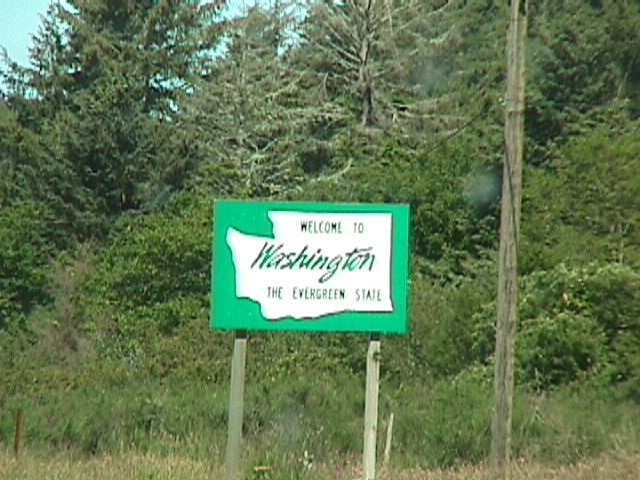
Washington -- the Evergreen State, or so says the welcome sign. Emerging from the hills of northern Idaho, just having basked in the lustre of the Coeur D'Alene Lake, if you'd never been here before you just might be fooled. Spokane is surprisingly green, for a major city anyway, but photosynthesis is definitely not the signature of the land due west. Gone are the mountains, the grass and trees; instead there is, by now this is becoming the cliché of the trip, nothing at all. Though it was the middle of summer, I thought about a certain Snow Man:

And, nothing himself, beholds
Nothing that is not there and the nothing that is.

And we wonder why we still listen to poets . . .

Things began to change a bit around the base of the Cascade Mountains. Around here the Columbia River basin provided such fertile land that white settlers removed the Wanapum Indian tribe that had called it home for generations, gradually at first but with climactic vigour in 1943, when the U.S. army decided it wanted to use the site as a production ground for the atomic bomb. Because they were peaceful and never actually fought the settlers -- this is almost too sad to believe! -- the Wanapums were never asked to sign a formal treaty with the U.S. government; as a result, the 'concessions' were, and continue to be, very few.

Now I don't know how much I owe my Uncle
But I suspect it's more than I can pay
He's asking me sign a three-year contract
I guess I'll catch the first bus out today.

So I'm heading for the nearest foreign border
Vancouver may be just my kind of town
'Cause they don't need the kind of law & order
That tends to keep a good man underground.

Thanks, Gram.

Passage through the Cascade Mountains is nothing short of metamorphic. It is as if all the chlorophyll absent in the eastern part of this only ostensibly seared state was somehow siphoned here. Our quick, verdant ascent proved a bit more precarious than I would've liked because of the rain. Man, did it rain -- I swear, there was no more sky. In fact, we were the sky for the rest of Washington, as the low-laying clouds wrapped around us at about 4,000 feet and flooded us with its floodwater deluge. Add to all this several cars racing by us at 75 and 80 mph and you'd find J. and me praying the sorts of pious prayers we only reserve for threatening moments like calls home and plane rides. What's that, Bob?

Oh, where have you been, my blue-eyed son?
Oh, where have you been, my darling young one?
I've stumbled on the side of twelve misty mountains,
I've walked and I've crawled on six crooked highways,
I've stepped in the middle of seven sad forests,
I've been out in front of a dozen dead oceans,
I've been ten thousand miles in the mouth of a graveyard,
And it's a hard, and it's a hard, it's a hard, and it's a hard,
And it's a hard rain's a-gonna fall.

The end of a long trip is sort of bittersweet, don't you think? Kind of like a kiss from a girl who just told you she just wanted to be friends. With this in mind, J. and I were very tired, somewhat cranky, pretty happy to see that Seattle was only 30 miles away, and unspeakably sad to see our trip so close to coming to an end. J. even joked that we could still drive back to Cincinnati, and I think he was referring to more than just his apprehension about starting his new job and life on the other side of the country. There is freedom -- a joy! -- in travelling that is unmatched. When you don't know for sure where you'll be in two hours, two days, or maybe even two weeks; where you don't know a soul, and yet, for better or worse, they don't know you either. You can be who you want to be, when you want to be, as you want to be. Travelling isn't just about the elusive search for 'singularity', which I remember reading once somewhere in a psychoanalytic textbook. No, where you're on the move, with an aimless aim, a ramble . . . a stroll, life takes on a transitory nature that I yearn for [ed. I still do.] -- a Sartrean momentary existence, if you will, that seeks 'to be' and nothing more, for that's all there is -- there is no 'not to be', and thus, Hamlet notwithstanding, hardly even a question. Where there is no pretence of whom I ought to be, where I ought to be (or going), and even less of whom or where I once was. A simple point that travelling reminds me of: we are only where we are, who we are -- indeed, where and who we are going to be -- now.

The dry eucalyptus seeks god in the rainy cloud.
Professor Eucalyptus of New Haven seeks him
In New Haven with an eye that does not look

Beyond the object. He sits in his room, beside
The window, close to the ramshankle spout in which
The rain falls with a ramshankle sound. He seeks

God in the object itself, without much choice.
It is a choice of the commodious adjective
For what he sees, it comes in the end to that:

The description that makes it divinity, still speech
As it touches the point of reverberation -- not grim
Reality but reality grimly seen

And spoken in paradisal parlance new
And in any case never grim, the human grim
That is part of the indifference of the eye

Indifferent to what it sees. The tink-tank
Of the rain in the spout is not a substitute.
It is of the essence not yet well-perceived. (W. Stevens, 'An Ordinary Evening in New Haven' [XIV])

So, yeah, we're here: Seattle, Washington. Only now do I realise my trip's two deepest regrets -- (1) That the trip wasn't nearly long enough, and (2) that I didn't tell J. enough through the years how good a friend he's been. One of the classic platitudes that I hear too often is that every ending is just another beginning. This seems very wrong to me. What if beginnings and endings are only for people who don't know, or who can't accept, where they are now and only now, realizing that each 'now' is not necessarily leading to anything or anywhere, that it is Indifferent? I am always at my destination if I recognize this. What of hope, one might ask. Hope is not just wishful thinking that things will turn out; rather, to be hope it must be a present reality, that is, a 'nowness' that is life in harmony with that for which is hoped. If one hopes for eternal life, an eternal moment, as it were, one should live the present moment in a way that is confluent with that hope. Why need life and hope be separated at all? More to the point right now, if I hope to be a good friend, and I should think there is little else to do with one's life, should I not now live as I believe a friend ought? Is there room for regret; or is that all there is?

Here, now, we forget each other and ourselves.
We feel the obscurity of an order, a whole,
A knowledge, that which arranged the rendezvous,

Within its vital boundary in the mind.
We say God and the imagination are one . . .
How high that highest candle lights the dark.

Out of this same light, out of the central mind,
We make a dwelling in the evening air,
In which being there together is enough. (W. Stevens, 'Final Soliloquy of the Interior Paramour')

Somehow, even whilst sitting alone on an empty plane over the middle of America I just spent a week traversing, neither journeys nor friendship are ever 'ended'. Closure is for wimps -- endings for the movies. I am always travelling -- 'now' cannot stand still. Life is, and nothing more. And that is all it truly need be.

Friday, June 13, 2003

Anger

Scott Martens is pissed, and he comes out of his blogging corner with a pugilist, (hopefully) cathartic rage that I can't say I've seen on his blog before. As it is, it's been a very very good week over at Pedantry, at least as far as the posts go. While you're reading today's, and really, DO SO, also check out his thought-provoking piece on collections vs. collectives.

Tuesday, June 10, 2003

'Step Up Bitch'

As I've declared in the past, I get letters! -- and I'm not ashamed to post them. This Silentio reader was drunk and pissed off (apparently at me, though he can no longer remember why) why he sent me this missive:

You have made more than one enemy you fucker. Come into town and don't even look at me wrong punk ass motherfucker. You have owned up and became your own man and that is fine, I respect that more than you being a pussy hiding behind what you think you have learned. Step up bitch!

One can never credit our little community here of not having a little spunk, eh? My first reaction was ... well, the first reaction was one of vague fright, because I know the emailer and he is quite a bit bigger than I. My second reaction was one of confusion. I wasn't bewildered by what I might've done or said to upset this person, because I say and do such things to a variety of person on a near-daily basis, mostly by accident. No no, I was curious about the phrase 'Step up bitch.' Was this some kind of new aerobic activity, I wondered. No, don't be silly, Brad, my thoughts continued, this is 'lingo' -- hip teen, vaguely ghetto, lingo even. Obviously, not only can one not say our little community here lacks spunk, one cannot deny that they are in the know about such things. Bless all your g-lovin' hearts! As for me, my only rap album, if you ignore the mid-80s / early-90s stuff by the likes of The Beastie Boys and A Tribe Called Quest is a two-year-old Eminem CD, which I own by proxy, via Katrien, and I would venture a guess that most of his plangent neologisms are pretty old by now. (I know it's not really slang or anything, but I've always been taken by the Wilderesque quip, 'Bleed, Bitch, bleeeeeeed . . . bleeeeeeed.') Just a guess -- don't come after me, Slim Shady.

It's times like these that one can be thankful for The Source for Youth Ministry, specifically their glossary of Teen Lingo. Faint-hearted youth ministers beware, the site warns:

This teen lingo represents today's culture and many of the problems that go along with it. Although much of it is humorous, a good portion of it is very offensive. Many of the words are terms for sexual activity and drug use. Many of the examples given are common quotes from youth today- these quotes, although somewhat edited, can be foul or vile (sadly, all the below phrases can be said in a PG movie). I believe this dictionary has educational value in helping youth workers understand teen mentality and culture, but please do use discretion.

Indeed, Mr. Source for Youth Ministry. I found myself both scandalized and educated -- a pedagogical method to be admired, I think we can all agree. Take a gander, paying especial attention to the definitions:

  • deebo: To steal. See "jack." Derived from the character in the movie "Friday", who steals from all of the neighborhood people. "I'm gonna deebo Mom's credit card."

  • five on it: Term used to imply that the person either has a nickel bag of weed to contribute, or is willing to pitch in 5 dollars toward the purchase of marijuana.
  • given up the gold: When a female gives up her virginity before the right time, usually before marriage. "Girl, why you given up the gold . . . you gonna be bankrupt later!"
  • High-five: HIV "Homey got the High-five from the skanch queen"

You get the idea, I'm sure. But I'd be remiss if I didn't add two more -- my favourites -- before I finish off my wine and get back to work:

  • I'll bust a cap in your #$&?!! (posterior): To shoot someone (not necessarily just in the gluteus maximus). "Man, you best stop mad dawging me or I'll bust a cap in your #$&?!!"
  • in the house: Not in an actual house but at a present gathering or location. "My man Will’s in da house!"

To invoke Eminem again, to prove that I'm 'off the heazy', and maybe even slightly 'off your rector' (which, now that I look at it, seems kind of dirty): 'Snap back to reality, oh there goes gravity'. In other words, methinks (and partly hopes -- as long as I get to see it in action) youth ministers, if they actually try using teenspeak for proselytising purposes, may very well achieve levels of geekiness hitherto completely unknown.

Montana, Fires, and God

Day Five

Today's drive was ornamented by thick haze and smoke from the thousands of acres of fires burning south of Missoula, Montana. In many ways, so I read in that morning in the Missoula Independent, this summer's fires are, in part, products of fire fighters doing their job a bit too well in years past. By putting out so many fires rather than letting them run their natural course and necessarily burning the forest's deadwood, Western fire fighters inadvertently created a forest overrun by dry, dead trees and brush. Or, in other words, fire fighters created a fire hazard. Talk about job security.

My point isn't to point a finger at the Forest Service, though it's often quite easy and often justifiable to do so, but to harp on a point that's bugged me, in these latter days of a diminishing religious faith. The saddest part of this summer's fire is that it really didn't have to be a disaster at all, but like so many 'acts of God' that destroy so much property and take so much life, an unfair share of the blame is accredited to an ethereal notion like God -- this without any significant recognition (i.e., anything that requires any significant behaviour / belief modification) that much of the blame falls squarely on the shoulders of God's most blessed creators, humanity. I obviously don't say this to defend God, for if God indeed is, would s/he need my defence? [ed. I know that, like jokes, irony is ruined when it has to be explained, but I really really hope everybody sees the irony in that link. Amazing what happens to a person in five years, huh?.]. It just seems to me that a humanistic society like ours [ed. One must remember, I wrote this in America, not Europe] should be willing to face the stark reality that we very regularly foul up, or at least magnify the consequences of, the ordinary, quotidian processes of nature and then pull out our dehumanising, it-was-out-of-our-hands appellation of choice: 'disaster'. For example, when Hurricane Andrew struck the coasts of North Carolina and Florida several years ago, the destruction was damn near total. What once was luxuriant beachfront property came to hearken the broken image (if only that) of a third-world country. What was lost in much of the ensuing talk of disaster is that much of the damage was due to contractors building very sub-par houses and buildings, in spite (because?) of their knowing the acute threat of hurricanes each spring. In other words, greed took precedence. Just as notorious, and far more deadly, is what happened in northwest Turkey this past year, when an earthquake claimed so many lives -- some 18,000 people -- primarily because many the country's (poorest) people were forced to live in cheap buildings that had been condemned, some repeatedly, as structurally unsound. The same is true in Argentina, where floods and mud slides trapped and killed over 30,000 people, once again most of them among the poorest, who, despite living near one of the largest cities in the world, could only afford living in very unstable and dangerous locations along mountain-sides. I'm not suggesting I have a cure for the social reality of poverty or the right method of urban renewal; I'm merely saying this is humanity's reality and problem, not a natural disaster. Nature is not compelled to work in confluence with the socio-cultural systems we've constructed, be they corrupt or legitimate. Perhaps instead of building a case for or against God, which in the end is only proving or judging the God of one's own image, we (esp. the survivors and/or those relatively unaffected) might be better served in always first assessing our own culpability before throwing up our hands with a sigh and saying, in essence, 'These things happen.'

Ahem. Our drive today was short, as if I really needed to type that again. From Butte to Seattle isn't really that far of a drive, a bit over six hundred miles, but J. and I, having realized we were still a day ahead of our schedule, decided there was little sense in pushing ourselves. Plus, I think we both get a little kick out of staying in a hotel in a strange town. So, not-so-long story even shorter, our Butte-stained eyes were set for Spokane.

After lunch in Missoula, where, I might add, I had one of the best cups of potato soup I've ever had, the highway very quickly led us into Idaho. I don't know about the rest of the state, but the narrow northern thoroughfare of Idaho is flat out gorgeous. Forest-green mountains outline the highway that weaves its way lazily through the lush forest. J. can tell you, I was giddy the whole through. The experience culminated when we reached Coeur D'Alene Lake, near the western border of Washington. Golden wisps of light sparkled off the lake like it was an oversized lamé. I've seen larger lakes, but none nearly as pretty.

Sadly, I learned in Spokane that this very same lake is threatened by pollution from the nearby mines in Kellogg, Idaho. Of course, the cleanup is now a political effort, as the Republican governor is claiming that because the EPA has done an inadequate job in the cleanup the state should take over. The only problem with this is that the state has had nearly 100 years to clean up the mining pollution and its only ever gotten worse. In the end, I don't care who funds the project and can but only hope that we avoid another piece of evidence against us as a species if we make it yet another Berkeley Pit. Birds of Idaho beware.

Just west of the Idaho border lays Spokane, and it was a much-needed reminder that cities do in fact still exist. The last thriving (?) city we saw (at least to our road-weary eyes) was in Iowa, with the possible exception of Sioux Falls, South Dakota, so one might understand our excitement and surprise when we actually, finally, got stuck in a god awful traffic jam. With great relief and sadness, simultaneously, it almost felt like home.

Saturday, June 07, 2003

About Me

I fear that Silentio might be becoming a bit more autobiographical than I originally thought it'd be, but people keep visiting and linking to it, so I'll go with what works -- though what I'm about to post might send a lot of you scurrying for the safer blogging environs of, say, Calpundit or Matthew Yglesias or Boing Bong or Douglas Rushkoff. So be it -- they're all kickass good blogs and should be read regularly anyway. But, for now, back to me....

I woke up this beautiful Saturday morning, strolled downstairs to the computer, and happened upon yet another online quiz -- the Personality Disorder Quiz -- and have since concluded that I am, well, a wee bit, but maybe only a little-so, relatively speaking, depending on who it is that reads my blog, off-kilter (and not only 'cause I still find it slightly entertaining to take online personality quizzes, even occasionally the ones in Cosmo). Case in point, the results from today's quiz:

DisorderRating
Paranoid:Moderate
Schizoid:High
Schizotypal:High
Antisocial:High
Borderline:Low
Histrionic:Moderate
Narcissistic:High
Avoidant:Moderate
Dependent:Low
Obsessive-Compulsive:Moderate

Ah, I feel pretty good coming clean about my Schizoid, Schizotypal, Antisocial and Narcissistic disorders. It's true what they say about getting things out in the open. Whew. Now, by the looks of my watch it's time for my daily primal scream therapy.

Friday, June 06, 2003

Of Montana

Day 4

The tedium of the drive began to take its toll today. J. and I have taken to staring off at nothing at all, speaking to no one in particular, and laughing at jokes nobody else hears. Such are the symptoms of profoundly, chronically deranged individuals, and yet we are (relatively) sane. We are, however, locked into the reality that we are over halfway to our destination and have completely run out of things to say to one another or to think to ourselves.

This was most readily apparent as we made our leave from Gillette this morning. Our ambitious destination was Missoula, Montana, a bit over six hundred miles west-northwest. The distance notwithstanding, we voiced a confidence in our capacity to make it there, no problem, no sweat -- we had, after all, so we reasoned, driven the same distance the first day of our journey. An excruciatingly long hour-and-a-half, one-hundred-mile drive to Sheridan, Wyoming, however, chipped away our breakfast-table confidence. Looking back now, I think we should've taken the hint around the small town of Buffalo, when a besotted bird flew out of nowhere into the windshield of J.'s truck, its chirrupless body left crumpled inside the rubber part of the driver-side windshield wiper. In typical fashion, J. completely wigged out and swerved across the road to the right, nearly hitting a bus filled with some mentally handicapped ladies we hit on back in Murdo, before he finally stopped the truck on the side of the highway. While he attended to the broken body of the bird, suggesting all the while that perhaps we needn't worry about stopping for lunch after all, I entertained myself by photographing a particularly scenic view of the timber-covered Bighorn Mountains with the pretty snazzy camera J. accidentally stole from a junior-high-aged camper the previous summer. (Don't ask.) Once we were back on the road I think we tacitly agreed that our suicidal bird portended a similar fate for us if we pushed ourselves too hard today. You never know when you're going to smack into reality when it's coming at you at 90 mph.

The next thing I remember we were in Montana. I do not remember driving through Sheridan; even scarier is neither does J., and he was the one doing the driving. Quite possibly I would not have even realized we were in Montana until we'd reached Billings, had it not been for the incessant construction that Montana peppers throughout their major interstate artery. What should have taken about an hour, from the border of Wyoming to Billings, ended up taking close to two hours because of a series of dizzying lane changes and blockages, the ultimate purpose of which I never learned. There is something singularly disheartening about construction traffic when you don't actually see anything being constructed. Much of it was confined to the Crow Indian Reservation, so perhaps this was one phase of their modern-day revenge on the white man -- which, excluding suntanned arms and faces at the time, J. and I most definitely are. If this is the case, good luck, Crow Indians. You've stumbled upon a plan that I expect should work flawlessly, what with America's constant trumpeting these days of its 'God-given' right to convenience and expedience.

To my shock and J.'s glee, the Toyota handled the ascent to Butte wonderfully. Ever since Murdo the trip has been increasingly, only sometimes obviously so, uphill, and I was excited to announce several times that at Butte we would reach our highest point at 5,767 feet above sea level! (I would say it with the exclamation point, no less). Until Montana, our ascent had been nearly imperceptibly gradual, but there is nothing gradual about the Rocky Mountains. They are as big as their roads are curvy, a fact made more harrowing by virtue of the speed limit remaining 75 miles an hour and J. complaining that his eyes were beginning to water and burn. With my fingers digging into the handle of my door and clenching my teeth tight as my ass in a 'Dear God, Don't Let Me Die This Way' terror fit only for roller-coasters and mid-Atlantic turbulence, we drove for fifty miles until we saw Our Lady of the Rockies beckoning us with her come hither virgin eyes from on high. The same height as the Statue of Liberty and modelled after (oops, did I just blaspheme?) Mary, but ecumenical in spirit ('Our Lady of the Rockies' does not represent or endorse any one faith,' or so the lady at the Visitor Centre assured me), the statue rests 3,500 feet above Butte along the Continental Divide and overlooks the city.

From what I can tell, Butte, Montana needs all the help it can get. If Rapid City was the town always on the verge of waking up, Butte seems always on the verge of falling asleep. Suffering from a long history of exploitation and bad environmental practices, Butte has fallen prey to its own success as a mining town and now has the dubious distinction of being the nation's largest Superfund clean-up site. Its water supply is contaminated by a highly acidic mixture of copper, zinc, lead, and arsenic, a homebrew that killed 342 migrating snow geese in 1995 when they mistook the liquid in the Berkeley Pit -- a massive 1.5 miles long, 1,800-foot deep open mining pit -- for drinkable water.

In keeping with the ecological state of the town, Butte had very little to offer when it comes to food as well; unless, that is, you wanted to regret a fast food meal later or loathe life now while eating in a casino. Maybe the citizens of Butte have simply grown accustomed to the imminent danger of their drinking water that the slow toll of these options aren't worth worrying about. J. and I figured that we should at least inject some money into the sagging Butte economy, so we ate at a small hot dog and pork chop sandwich place -- he an ample pork chop sandwich and I a brackish hot dog -- that looked, appropriately, as though it had been around the block a few times and was in dire need of some heavy-duty renovation.

Now that I think about it, maybe the bird from earlier was wrong. The 120-mile drive to Missoula doesn't seem so bad right now. Nevertheless, if you will excuse me I need to practice holding my breath so I can take a shower later and get the smell of this hot dog off me.

Tuesday, June 03, 2003

Any More Doubters

I should hope that by now that his naysayers have been effectively silenced and stilled, cursing furtively into their elbows, but just in case anybody still has any doubts about Salam Pax being a real, live Iraqi blogger -- just like in a zoo, see!! -- and don't wish to be proven wrong by that insidious hotbed of liberal lies, The Guardian, take a look at Peter Maas' article over at Slate. It's not the most interesting article, I will be the first to admit, but Salam is a good enough blogger for some extra, though unnecessary (in my book), vindication.

Personally, it would not have bothered me at all if Salam turned out to be a 15-year-old kid in Peoria, because his is a damn fine blog, fact or fiction. As I was telling Crak today, and much to his consternation, even if Salam wasn't 'real' his take on the events in Iraq, first-person or otherwise, were as good, if not better, than any other so-called credible news outlet we had in Iraq before, during, and after the war. The Salam's blog was a fiction, the more fiction the better, I say! Unfortunately, he's now played the 'truth' card, trumping the most vociferous of his doubters; unfortunately this means that it's all the more difficult now to renege and parlay the 'truth' into outright fiction without it more or less transmogrifying into lies, damn lies. *sigh* Oh well, what the hell -- you've given us the truth thus far, Salam, now gives us the lies we need and expect from our Middle East correspondents. You're getting paid now -- assume the proper position, and I'll do the same.

Monday, June 02, 2003

Moving On

Day Three (2)

Our next stop was Keystone, South Dakota, whose sole claim to fame is that Mount Rushmore just happened to be blasted into the side of a nearby mountain. Keystone had the instant feeling of Gatlinburg, Tennessee, with its flashing lights, Christmas-themed stores, and overweight people wearing tank-tops. By the time we got to Mount Rushmore, and in spite of it being an awesome feat in its scale and sight, I got the feeling that I'd been there before. It is such a natural icon, much like the Statue of Liberty, that when you actually see it, you can't help but be a bit disappointed that it's not any different from the pictures you've grown up with. Whenever I go to places like this, the same thing happens. I pay an ungodly amount of money to see something I could've seen from a distance for free; I get caught in a conversation with an old man who's lost his wife; I see the monument, stand there for a few minutes, and then feel a bit unsure of what to do next in order to get my money's worth, usually resulting in me finding the nearest pamphlet booth or informational video. To make matters worse, J. refused to stop off and check out the mysterious Cosmos Ball that we'd been seeing advertised for the last 200 miles -- 'It's mysterious' 'It's funky'.

We had to pass through Rapid City, South Dakota on our way to and from Mt. Rushmore, and I'm sad to say that Rapid City is in dire need of a face-lift. Standing in the shadow of some of the most incredible landscapes in the country and itself the largest city in western South Dakota, one would imagine that Rapid City would see the need to impress tourists more than it does. Maybe it was the weather, but there seemed a perpetual grey hanging over the city, causing it to seem like a city always on the verge of waking up but never quite doing so. There is plenty of potential: wonderful location, nice size, and even a decent, if a bit generic, name. And yet I don't get the impression that it's waking from its slumber anytime soon. Like so much of the West, it seems more likely that it will rest on the laurels of its (relatively recent) past, reliving the 'glory days' of the Wild West, and leaving the I-90 tourists with nothing but ideas of how nice it could've been with just a little effort. At least Iowa tried!

With the afternoon slowly escaping us, and J. and I giving up on the notion of making any real distance today, we decided to check out what Teddy Roosevelt saw in Devil's Tower National Monument when he made it America's first official National Monument. Rising (literally - it's still 'growing') about 900 feet into the sky, Devil's tower from a distance looks like an enormous tree stump. It stands alone, save for a few surrounding hills, and one quickly understands why so many American Indians regard it as a place of religious significance. (Because, obviously, they were not as sophisticated as we, who know how to use such monuments. Savages.) Today it is climbed by over a thousand people a year, so the lustre of its mysterious summit is gone, as is its origin -- it was formed by magma shooting up from the earth but having nowhere to go. I found it an unsettling contrast to the underachieving of Rapid City. To harsh of juxtaposition in a day filled with too many already.

By the time we got back on I-90, J. and I were ready to call it a night at Gillette, Wyoming -- no relation, it turns out, to the razor. We washed up at our Super 8 Hotel and walked across the parking lot, hungry only for a large pizza but getting a large pizza and a dozen screaming children. Oh, I'm mistaken. They weren't just screaming, they were also rolling themselves on the floor around our table. I swear, it was something out of a Pentecostal church or something. I sometimes don't understand parents who just let their kids do whatever they please. It's one thing to let them get away with bloody murder at home, but in public? I even heard one of the ladies, mouth filled with a slice of Pepperoni Lover's pizza, outside and in, say something about how well behaved her daughter was, despite the fact it was her daughter who kept throwing a ball at me the whole time I was there. Little bastard. She and that boy from the prairie dog farm ought to get together.

I'm not sure how I feel about the day as I type this. There was so much good, but much of it was inexpressibly good; and yet, at the same time, there was so much expressibly bad that also happened. It feels so good to be unexplainably happy, and yet remain irrationally bitchy. Sounds like a fun person to travel with, huh?

Just too Much

I'd intended on providing a little commercial break from the belated tale of my travels of old by scavenging through my usual array of news and commentary, but there's just too much. But, Brad -- you say -- there's no war going on, CNN doesn't know what to do with itself, it's a slow news month! Hooey! From the relaxation of FCC rules (Neal Pollack is especially good on this) to the Christian terrorist / nutter / bomber Eric Rudolph's arrest in North Carolina to well-intentioned if equally nutty G-8 Conference protesters to the general daily disingenuous, tax-cutting shenanigans of our fuckwit of a President ("I'll bet you're the kinda guy that would fuck a person in the ass and not even have the goddamn common courtesy to give him a reach-around. I'll be watching you") to a staggeringly high death toll of southern India's latest heat wave to a very unpopular war that's still killing U.S. soldiers to . . . well, you get the idea. There's lots going on. Too much. There are bloggers far better, and who have far more time, than I to equip you with the talking points. Many of them are linked on the right-hand side of this page -- all of them (yeah, I know some are dead links, I really need to get on that) are worth checking out. In the meantime, I'll take leave from this post with a quote. A commercial break, we might say:

By exercising great and manifold skill we manage to produce a dazzling deception by the aid of which we are capable of living alongside the most uncanny things and remaining perfectly calm by it, because we recognise these frozen grimaces of the universe as a table or a chair, a shout or an outstretched arm, a speed or a roast chicken. We are capable of living between one open chasm of the sky above our heads and one slightly camouflaged chasm of the sky beneath our feet, feeling ourselves as untroubled on the earth as in a room with the door locked. We know that life ebbs away both out into the inhuman distances of interstellar space and down into the inhuman construction of the atom-world; but in between there is a stratum of forms that we treat as the things that make up the world, without letting ourselves be in the least disturbed by the fact that this signifies nothing but a preference given to the sense-data received from a certain middle distance. Such an attitude lies considerably below the potentiality of our intellect, but precisely this proves that our feelings play a large part in all this. And in fact the most important intellectual devices produced by mankind serve the preservation of a constant state of mind, and all the emotions, all the passions in the world are a mere nothing compared to the vast but utterly unconscious effort that mankind makes in order to maintain its exalted peace of mind. (Robert Musil, Mann ohne Eigenschaften [The Man Without Qualities])

Onward ho!

I truly doubt anybody is reading this travelogue, but we can't just abandon our forlorn travellers two days into America's Heartland, can we? Well, you may be able to, but dammit I can't!! Onward, we go . . . thus begins a two-part day.

* * * * * * *

Day Three (1)

The morning began with a jolt I neither expected nor welcomed: an email from J. had enquiring if I'd been fired yet. As one might expect, I was somewhat taken aback by this question, and only mildly concerned by what I regarded to be thinly-veiled Aussie irony, so I replied with a curt, 'What the hell are you talking about?' It turns out, so I learned at the adjacent McDonalds, where I broke down and gave him a call, I had been doing internet development (as a student) for the school without being eligible for work-study government funding. Because of this, since clocking out a couple of days ago, the federal government had begun dunning my boss for $10,000 dollars. The upshot of this, pretty obviously, is that I was more or less out of a job; more importantly, because he was also a friend, my boss now suspected that I might be attempting to scam him out of money. [ed. Fortunately, a friend at the college went to bat for me and began asking questions on my behalf, and quickly discovered that I had simply failed to fill out some paperwork that would've easily made me eligible. Granted, I still didn't get my job back, but I also doubt that my boss had to pay that $10,000. A regular reader, and former co-worker, can attest that the website we maintained never re-achieved its ill-gotten glory after our departures. ]

Needless to say, I left Murdo in a rather pissy moody. I've never been a good employee, but neither have I ever been unemployment -- the fact that the incongruity might right itself eventually never occurred to me, and I burked its realisation even further as I sipped my Coke and crunched my ice, grumbling to myself and creating an odd assortments of hyphenated cursing that would always begin with 'fucking' and end with 'shit'. It is times like this, I decided, about one hundred miles west of Murdo, standing at an ATM in a mosquito-infested, mephitic Shell station, that you begin to learn something about yourself, the stuff you are made of, not to mention how much money you currently have in your checking account.

There is a scenic highway that runs through the B(r)adlands National Park for thirty-eight miles and rejoins I-90 at Wall, South Dakota. I was eager to get my mind off my morning troubles, and I thought such a drive might just be the thing. We stopped off at a farm that lets you see and feed prairie dogs, contributing, I concluded later, to the further bastardisation of nature. [ed. One of these days, remind me, and I'll write something about my feeling, ironic or not, that all national parks should be completely closed to the public.] Still in a pissy mood, I glared a hole into a child when he effectively scared away a couple of prairie dogs that were obviously posing for me as they ate. Little bastard.

The Badlands National Park is easily one of the oddest-looking places I've ever been. Erupting out of the sublimely jejune South Dakota grassland like a nasty looking rash on perfect skin, you can't help but wonder how in the world they it got there; though, I should point out, I was told by a father of two -- one of which was in a baby-carrier on his stomach, while the other apparently fell off a cliff somewhere because he failed to respond to his father's calls the whole time I was in the gift shop -- that there is a really nice movie detailing its geological history, a movie I did not get a chance to see because J. threatened to drive away were I to do so. So anyway, one minute you're shelling out eight bucks for a pass to the park that lasts seven days, and looking at nothing but grass; the next minute you're confronted with a seared masterpiece that just goes on and on. There's not enough horizon for some of it. J. and I walked around for a couple of miles, lumbering, often tripping, over slippery rocks, and then drove further into the park, stopping occasionally for scenic views off cliffs that made my already gingerly-placed foot quiver. The thirty-eight miles inside the park, while very nice and well worth the money, were a bit taxing. By the middle of the drive every gorgeous view, while definitely imbued with a majestic enormity one rarely finds back East, began to feel like the same view from two miles ago. I kept taking pictures, though, in hopes that I might notice something particularly fetching when I viewed them all back home.

We left the Badlands, very tired, very hungry, but also very excited about our next stop: Wall, South Dakota. I had watched a short documentary about the Wall Drugs store, but it's really something you have to experience to truly appreciate (or depreciate, as the case may be with J.). The moment you cross the border into South Dakota from Iowa, you're bombarded with so many roadside advertisements, some more clever than others, for Wall Drugs that you'll be forgiven for thinking it were some ubiquitous chain along the lines of Wal-Greens. Not so. Opened in the early 1900s, if the Discover Channel is to be believed, Wall Drugs didn't really catch on until the Great Depression, when its owners started distributing free ice water to travellers on their way to better times in the West. Such a humble beginning is surprising considering its contemporary bombastic presence (it takes up a city full block) in the otherwise very uninspiring town of Wall. There are no fewer than four entrances, all of which lead into a virtual mall -- but it all manages to remain but one store. There are a couple of restaurants, endless places to buy useless items like miniature model horses and Wall Drugs t-shirts, a chapel, an arcade, rows and rows of interesting historical photographs (well worth the stop in themselves), a fine collection of Western Art, a large mechanical dinosaur that roars every twelve minutes (along with the obligatory sulfur breath that all dinosaurs must've had), and several statues of eight foot rabbits. I left Wall with my spirits considerably lifted. I might be unemployed, but I'll be damned if I didn't get a great picture of J. looking as though he were being sodomized by a six-foot rabbit [ed. That's not J. in the photo.].