Saturday, June 07, 2003

About Me

I fear that Silentio might be becoming a bit more autobiographical than I originally thought it'd be, but people keep visiting and linking to it, so I'll go with what works -- though what I'm about to post might send a lot of you scurrying for the safer blogging environs of, say, Calpundit or Matthew Yglesias or Boing Bong or Douglas Rushkoff. So be it -- they're all kickass good blogs and should be read regularly anyway. But, for now, back to me....

I woke up this beautiful Saturday morning, strolled downstairs to the computer, and happened upon yet another online quiz -- the Personality Disorder Quiz -- and have since concluded that I am, well, a wee bit, but maybe only a little-so, relatively speaking, depending on who it is that reads my blog, off-kilter (and not only 'cause I still find it slightly entertaining to take online personality quizzes, even occasionally the ones in Cosmo). Case in point, the results from today's quiz:

DisorderRating
Paranoid:Moderate
Schizoid:High
Schizotypal:High
Antisocial:High
Borderline:Low
Histrionic:Moderate
Narcissistic:High
Avoidant:Moderate
Dependent:Low
Obsessive-Compulsive:Moderate

Ah, I feel pretty good coming clean about my Schizoid, Schizotypal, Antisocial and Narcissistic disorders. It's true what they say about getting things out in the open. Whew. Now, by the looks of my watch it's time for my daily primal scream therapy.

Friday, June 06, 2003

Of Montana

Day 4

The tedium of the drive began to take its toll today. J. and I have taken to staring off at nothing at all, speaking to no one in particular, and laughing at jokes nobody else hears. Such are the symptoms of profoundly, chronically deranged individuals, and yet we are (relatively) sane. We are, however, locked into the reality that we are over halfway to our destination and have completely run out of things to say to one another or to think to ourselves.

This was most readily apparent as we made our leave from Gillette this morning. Our ambitious destination was Missoula, Montana, a bit over six hundred miles west-northwest. The distance notwithstanding, we voiced a confidence in our capacity to make it there, no problem, no sweat -- we had, after all, so we reasoned, driven the same distance the first day of our journey. An excruciatingly long hour-and-a-half, one-hundred-mile drive to Sheridan, Wyoming, however, chipped away our breakfast-table confidence. Looking back now, I think we should've taken the hint around the small town of Buffalo, when a besotted bird flew out of nowhere into the windshield of J.'s truck, its chirrupless body left crumpled inside the rubber part of the driver-side windshield wiper. In typical fashion, J. completely wigged out and swerved across the road to the right, nearly hitting a bus filled with some mentally handicapped ladies we hit on back in Murdo, before he finally stopped the truck on the side of the highway. While he attended to the broken body of the bird, suggesting all the while that perhaps we needn't worry about stopping for lunch after all, I entertained myself by photographing a particularly scenic view of the timber-covered Bighorn Mountains with the pretty snazzy camera J. accidentally stole from a junior-high-aged camper the previous summer. (Don't ask.) Once we were back on the road I think we tacitly agreed that our suicidal bird portended a similar fate for us if we pushed ourselves too hard today. You never know when you're going to smack into reality when it's coming at you at 90 mph.

The next thing I remember we were in Montana. I do not remember driving through Sheridan; even scarier is neither does J., and he was the one doing the driving. Quite possibly I would not have even realized we were in Montana until we'd reached Billings, had it not been for the incessant construction that Montana peppers throughout their major interstate artery. What should have taken about an hour, from the border of Wyoming to Billings, ended up taking close to two hours because of a series of dizzying lane changes and blockages, the ultimate purpose of which I never learned. There is something singularly disheartening about construction traffic when you don't actually see anything being constructed. Much of it was confined to the Crow Indian Reservation, so perhaps this was one phase of their modern-day revenge on the white man -- which, excluding suntanned arms and faces at the time, J. and I most definitely are. If this is the case, good luck, Crow Indians. You've stumbled upon a plan that I expect should work flawlessly, what with America's constant trumpeting these days of its 'God-given' right to convenience and expedience.

To my shock and J.'s glee, the Toyota handled the ascent to Butte wonderfully. Ever since Murdo the trip has been increasingly, only sometimes obviously so, uphill, and I was excited to announce several times that at Butte we would reach our highest point at 5,767 feet above sea level! (I would say it with the exclamation point, no less). Until Montana, our ascent had been nearly imperceptibly gradual, but there is nothing gradual about the Rocky Mountains. They are as big as their roads are curvy, a fact made more harrowing by virtue of the speed limit remaining 75 miles an hour and J. complaining that his eyes were beginning to water and burn. With my fingers digging into the handle of my door and clenching my teeth tight as my ass in a 'Dear God, Don't Let Me Die This Way' terror fit only for roller-coasters and mid-Atlantic turbulence, we drove for fifty miles until we saw Our Lady of the Rockies beckoning us with her come hither virgin eyes from on high. The same height as the Statue of Liberty and modelled after (oops, did I just blaspheme?) Mary, but ecumenical in spirit ('Our Lady of the Rockies' does not represent or endorse any one faith,' or so the lady at the Visitor Centre assured me), the statue rests 3,500 feet above Butte along the Continental Divide and overlooks the city.

From what I can tell, Butte, Montana needs all the help it can get. If Rapid City was the town always on the verge of waking up, Butte seems always on the verge of falling asleep. Suffering from a long history of exploitation and bad environmental practices, Butte has fallen prey to its own success as a mining town and now has the dubious distinction of being the nation's largest Superfund clean-up site. Its water supply is contaminated by a highly acidic mixture of copper, zinc, lead, and arsenic, a homebrew that killed 342 migrating snow geese in 1995 when they mistook the liquid in the Berkeley Pit -- a massive 1.5 miles long, 1,800-foot deep open mining pit -- for drinkable water.

In keeping with the ecological state of the town, Butte had very little to offer when it comes to food as well; unless, that is, you wanted to regret a fast food meal later or loathe life now while eating in a casino. Maybe the citizens of Butte have simply grown accustomed to the imminent danger of their drinking water that the slow toll of these options aren't worth worrying about. J. and I figured that we should at least inject some money into the sagging Butte economy, so we ate at a small hot dog and pork chop sandwich place -- he an ample pork chop sandwich and I a brackish hot dog -- that looked, appropriately, as though it had been around the block a few times and was in dire need of some heavy-duty renovation.

Now that I think about it, maybe the bird from earlier was wrong. The 120-mile drive to Missoula doesn't seem so bad right now. Nevertheless, if you will excuse me I need to practice holding my breath so I can take a shower later and get the smell of this hot dog off me.

Tuesday, June 03, 2003

Any More Doubters

I should hope that by now that his naysayers have been effectively silenced and stilled, cursing furtively into their elbows, but just in case anybody still has any doubts about Salam Pax being a real, live Iraqi blogger -- just like in a zoo, see!! -- and don't wish to be proven wrong by that insidious hotbed of liberal lies, The Guardian, take a look at Peter Maas' article over at Slate. It's not the most interesting article, I will be the first to admit, but Salam is a good enough blogger for some extra, though unnecessary (in my book), vindication.

Personally, it would not have bothered me at all if Salam turned out to be a 15-year-old kid in Peoria, because his is a damn fine blog, fact or fiction. As I was telling Crak today, and much to his consternation, even if Salam wasn't 'real' his take on the events in Iraq, first-person or otherwise, were as good, if not better, than any other so-called credible news outlet we had in Iraq before, during, and after the war. The Salam's blog was a fiction, the more fiction the better, I say! Unfortunately, he's now played the 'truth' card, trumping the most vociferous of his doubters; unfortunately this means that it's all the more difficult now to renege and parlay the 'truth' into outright fiction without it more or less transmogrifying into lies, damn lies. *sigh* Oh well, what the hell -- you've given us the truth thus far, Salam, now gives us the lies we need and expect from our Middle East correspondents. You're getting paid now -- assume the proper position, and I'll do the same.

Monday, June 02, 2003

Moving On

Day Three (2)

Our next stop was Keystone, South Dakota, whose sole claim to fame is that Mount Rushmore just happened to be blasted into the side of a nearby mountain. Keystone had the instant feeling of Gatlinburg, Tennessee, with its flashing lights, Christmas-themed stores, and overweight people wearing tank-tops. By the time we got to Mount Rushmore, and in spite of it being an awesome feat in its scale and sight, I got the feeling that I'd been there before. It is such a natural icon, much like the Statue of Liberty, that when you actually see it, you can't help but be a bit disappointed that it's not any different from the pictures you've grown up with. Whenever I go to places like this, the same thing happens. I pay an ungodly amount of money to see something I could've seen from a distance for free; I get caught in a conversation with an old man who's lost his wife; I see the monument, stand there for a few minutes, and then feel a bit unsure of what to do next in order to get my money's worth, usually resulting in me finding the nearest pamphlet booth or informational video. To make matters worse, J. refused to stop off and check out the mysterious Cosmos Ball that we'd been seeing advertised for the last 200 miles -- 'It's mysterious' 'It's funky'.

We had to pass through Rapid City, South Dakota on our way to and from Mt. Rushmore, and I'm sad to say that Rapid City is in dire need of a face-lift. Standing in the shadow of some of the most incredible landscapes in the country and itself the largest city in western South Dakota, one would imagine that Rapid City would see the need to impress tourists more than it does. Maybe it was the weather, but there seemed a perpetual grey hanging over the city, causing it to seem like a city always on the verge of waking up but never quite doing so. There is plenty of potential: wonderful location, nice size, and even a decent, if a bit generic, name. And yet I don't get the impression that it's waking from its slumber anytime soon. Like so much of the West, it seems more likely that it will rest on the laurels of its (relatively recent) past, reliving the 'glory days' of the Wild West, and leaving the I-90 tourists with nothing but ideas of how nice it could've been with just a little effort. At least Iowa tried!

With the afternoon slowly escaping us, and J. and I giving up on the notion of making any real distance today, we decided to check out what Teddy Roosevelt saw in Devil's Tower National Monument when he made it America's first official National Monument. Rising (literally - it's still 'growing') about 900 feet into the sky, Devil's tower from a distance looks like an enormous tree stump. It stands alone, save for a few surrounding hills, and one quickly understands why so many American Indians regard it as a place of religious significance. (Because, obviously, they were not as sophisticated as we, who know how to use such monuments. Savages.) Today it is climbed by over a thousand people a year, so the lustre of its mysterious summit is gone, as is its origin -- it was formed by magma shooting up from the earth but having nowhere to go. I found it an unsettling contrast to the underachieving of Rapid City. To harsh of juxtaposition in a day filled with too many already.

By the time we got back on I-90, J. and I were ready to call it a night at Gillette, Wyoming -- no relation, it turns out, to the razor. We washed up at our Super 8 Hotel and walked across the parking lot, hungry only for a large pizza but getting a large pizza and a dozen screaming children. Oh, I'm mistaken. They weren't just screaming, they were also rolling themselves on the floor around our table. I swear, it was something out of a Pentecostal church or something. I sometimes don't understand parents who just let their kids do whatever they please. It's one thing to let them get away with bloody murder at home, but in public? I even heard one of the ladies, mouth filled with a slice of Pepperoni Lover's pizza, outside and in, say something about how well behaved her daughter was, despite the fact it was her daughter who kept throwing a ball at me the whole time I was there. Little bastard. She and that boy from the prairie dog farm ought to get together.

I'm not sure how I feel about the day as I type this. There was so much good, but much of it was inexpressibly good; and yet, at the same time, there was so much expressibly bad that also happened. It feels so good to be unexplainably happy, and yet remain irrationally bitchy. Sounds like a fun person to travel with, huh?

Just too Much

I'd intended on providing a little commercial break from the belated tale of my travels of old by scavenging through my usual array of news and commentary, but there's just too much. But, Brad -- you say -- there's no war going on, CNN doesn't know what to do with itself, it's a slow news month! Hooey! From the relaxation of FCC rules (Neal Pollack is especially good on this) to the Christian terrorist / nutter / bomber Eric Rudolph's arrest in North Carolina to well-intentioned if equally nutty G-8 Conference protesters to the general daily disingenuous, tax-cutting shenanigans of our fuckwit of a President ("I'll bet you're the kinda guy that would fuck a person in the ass and not even have the goddamn common courtesy to give him a reach-around. I'll be watching you") to a staggeringly high death toll of southern India's latest heat wave to a very unpopular war that's still killing U.S. soldiers to . . . well, you get the idea. There's lots going on. Too much. There are bloggers far better, and who have far more time, than I to equip you with the talking points. Many of them are linked on the right-hand side of this page -- all of them (yeah, I know some are dead links, I really need to get on that) are worth checking out. In the meantime, I'll take leave from this post with a quote. A commercial break, we might say:

By exercising great and manifold skill we manage to produce a dazzling deception by the aid of which we are capable of living alongside the most uncanny things and remaining perfectly calm by it, because we recognise these frozen grimaces of the universe as a table or a chair, a shout or an outstretched arm, a speed or a roast chicken. We are capable of living between one open chasm of the sky above our heads and one slightly camouflaged chasm of the sky beneath our feet, feeling ourselves as untroubled on the earth as in a room with the door locked. We know that life ebbs away both out into the inhuman distances of interstellar space and down into the inhuman construction of the atom-world; but in between there is a stratum of forms that we treat as the things that make up the world, without letting ourselves be in the least disturbed by the fact that this signifies nothing but a preference given to the sense-data received from a certain middle distance. Such an attitude lies considerably below the potentiality of our intellect, but precisely this proves that our feelings play a large part in all this. And in fact the most important intellectual devices produced by mankind serve the preservation of a constant state of mind, and all the emotions, all the passions in the world are a mere nothing compared to the vast but utterly unconscious effort that mankind makes in order to maintain its exalted peace of mind. (Robert Musil, Mann ohne Eigenschaften [The Man Without Qualities])

Onward ho!

I truly doubt anybody is reading this travelogue, but we can't just abandon our forlorn travellers two days into America's Heartland, can we? Well, you may be able to, but dammit I can't!! Onward, we go . . . thus begins a two-part day.

* * * * * * *

Day Three (1)

The morning began with a jolt I neither expected nor welcomed: an email from J. had enquiring if I'd been fired yet. As one might expect, I was somewhat taken aback by this question, and only mildly concerned by what I regarded to be thinly-veiled Aussie irony, so I replied with a curt, 'What the hell are you talking about?' It turns out, so I learned at the adjacent McDonalds, where I broke down and gave him a call, I had been doing internet development (as a student) for the school without being eligible for work-study government funding. Because of this, since clocking out a couple of days ago, the federal government had begun dunning my boss for $10,000 dollars. The upshot of this, pretty obviously, is that I was more or less out of a job; more importantly, because he was also a friend, my boss now suspected that I might be attempting to scam him out of money. [ed. Fortunately, a friend at the college went to bat for me and began asking questions on my behalf, and quickly discovered that I had simply failed to fill out some paperwork that would've easily made me eligible. Granted, I still didn't get my job back, but I also doubt that my boss had to pay that $10,000. A regular reader, and former co-worker, can attest that the website we maintained never re-achieved its ill-gotten glory after our departures. ]

Needless to say, I left Murdo in a rather pissy moody. I've never been a good employee, but neither have I ever been unemployment -- the fact that the incongruity might right itself eventually never occurred to me, and I burked its realisation even further as I sipped my Coke and crunched my ice, grumbling to myself and creating an odd assortments of hyphenated cursing that would always begin with 'fucking' and end with 'shit'. It is times like this, I decided, about one hundred miles west of Murdo, standing at an ATM in a mosquito-infested, mephitic Shell station, that you begin to learn something about yourself, the stuff you are made of, not to mention how much money you currently have in your checking account.

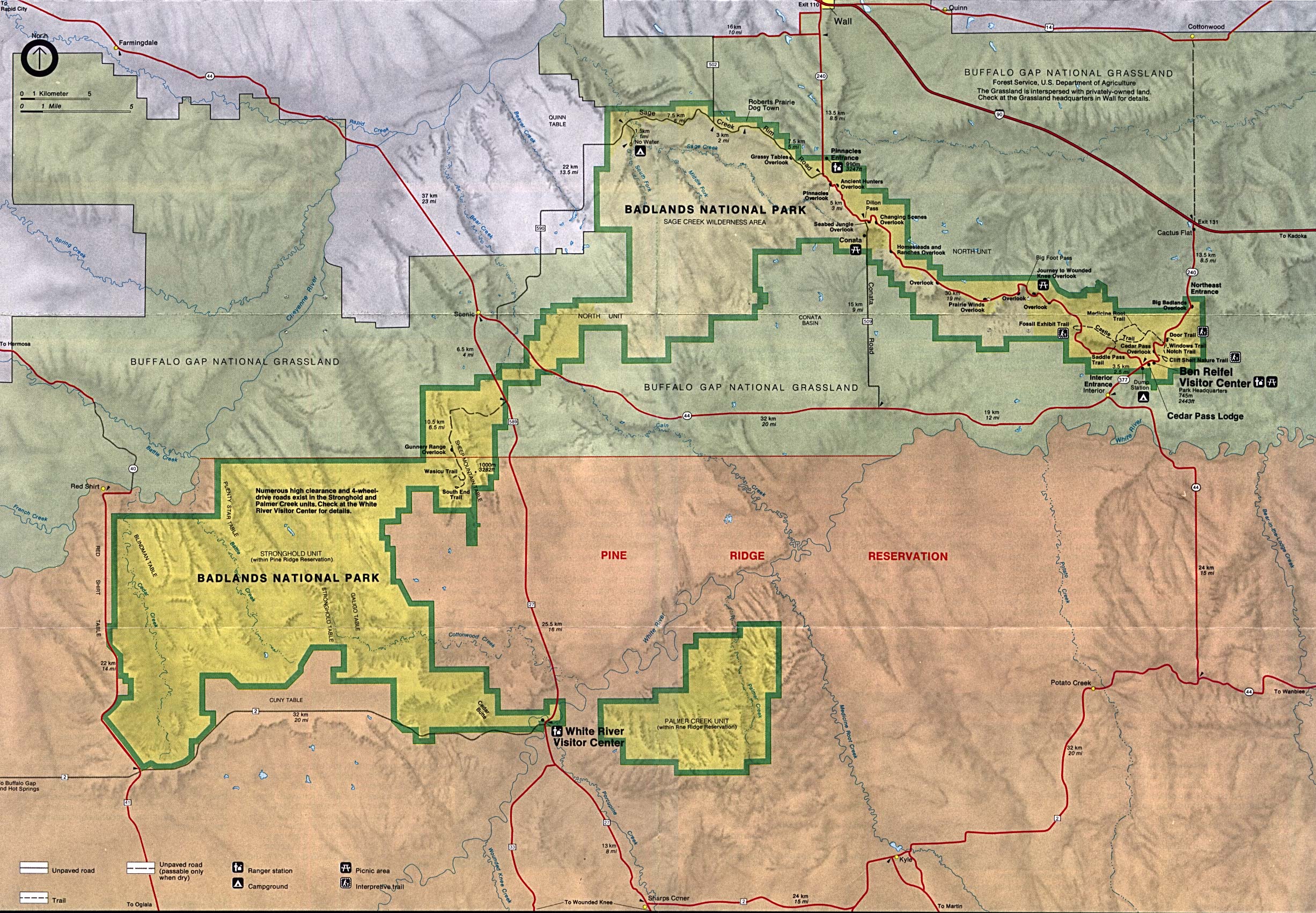
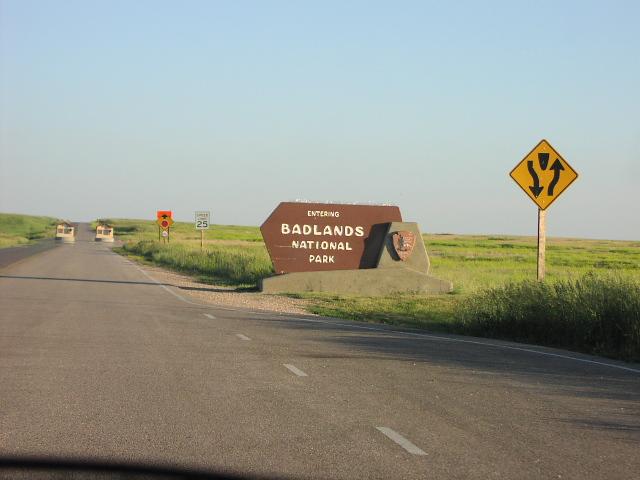
There is a scenic highway that runs through the B(r)adlands National Park for thirty-eight miles and rejoins I-90 at Wall, South Dakota. I was eager to get my mind off my morning troubles, and I thought such a drive might just be the thing. We stopped off at a farm that lets you see and feed prairie dogs, contributing, I concluded later, to the further bastardisation of nature. [ed. One of these days, remind me, and I'll write something about my feeling, ironic or not, that all national parks should be completely closed to the public.] Still in a pissy mood, I glared a hole into a child when he effectively scared away a couple of prairie dogs that were obviously posing for me as they ate. Little bastard.

The Badlands National Park is easily one of the oddest-looking places I've ever been. Erupting out of the sublimely jejune South Dakota grassland like a nasty looking rash on perfect skin, you can't help but wonder how in the world they it got there; though, I should point out, I was told by a father of two -- one of which was in a baby-carrier on his stomach, while the other apparently fell off a cliff somewhere because he failed to respond to his father's calls the whole time I was in the gift shop -- that there is a really nice movie detailing its geological history, a movie I did not get a chance to see because J. threatened to drive away were I to do so. So anyway, one minute you're shelling out eight bucks for a pass to the park that lasts seven days, and looking at nothing but grass; the next minute you're confronted with a seared masterpiece that just goes on and on. There's not enough horizon for some of it. J. and I walked around for a couple of miles, lumbering, often tripping, over slippery rocks, and then drove further into the park, stopping occasionally for scenic views off cliffs that made my already gingerly-placed foot quiver. The thirty-eight miles inside the park, while very nice and well worth the money, were a bit taxing. By the middle of the drive every gorgeous view, while definitely imbued with a majestic enormity one rarely finds back East, began to feel like the same view from two miles ago. I kept taking pictures, though, in hopes that I might notice something particularly fetching when I viewed them all back home.

We left the Badlands, very tired, very hungry, but also very excited about our next stop: Wall, South Dakota. I had watched a short documentary about the Wall Drugs store, but it's really something you have to experience to truly appreciate (or depreciate, as the case may be with J.). The moment you cross the border into South Dakota from Iowa, you're bombarded with so many roadside advertisements, some more clever than others, for Wall Drugs that you'll be forgiven for thinking it were some ubiquitous chain along the lines of Wal-Greens. Not so. Opened in the early 1900s, if the Discover Channel is to be believed, Wall Drugs didn't really catch on until the Great Depression, when its owners started distributing free ice water to travellers on their way to better times in the West. Such a humble beginning is surprising considering its contemporary bombastic presence (it takes up a city full block) in the otherwise very uninspiring town of Wall. There are no fewer than four entrances, all of which lead into a virtual mall -- but it all manages to remain but one store. There are a couple of restaurants, endless places to buy useless items like miniature model horses and Wall Drugs t-shirts, a chapel, an arcade, rows and rows of interesting historical photographs (well worth the stop in themselves), a fine collection of Western Art, a large mechanical dinosaur that roars every twelve minutes (along with the obligatory sulfur breath that all dinosaurs must've had), and several statues of eight foot rabbits. I left Wall with my spirits considerably lifted. I might be unemployed, but I'll be damned if I didn't get a great picture of J. looking as though he were being sodomized by a six-foot rabbit [ed. That's not J. in the photo.].

Wednesday, May 28, 2003

I Love South Dakota!

I meant to post this yesterday, but never got around to it. If all goes well, I'll post Day Three tonight... but I'm not holding my breath on that one, since I'm also hoping to watch the Champions League final. We'll see. Anyway, in today's entry our heroes are in Iowa and South Dakota. Good times, they were.

* * * * * * *

Day Two

J. and I got up this morning with an amazing, unforeseen ease. After our bellies were filled with a nutriciously mighty amount of donuts, we set our sights westward, beyond the flat-chested glare of central Iowa to what would prove to be the rolling hills of western and north-western Iowa. The drive was serene, so serene, in fact, that neither of us realized it when we had already driven nearly two hundred miles and it was lunch time in Sioux City, Iowa. Never has a border town been such a welcome sight. I really can't express the sheer drudgery of a drive through Iowa. I can, however, cite but one example. Somewhere south of Sioux City, J.'s peripatetic gaze fell upon an arresting sight: a sign that read 'Scenic View Ahead'. In the course of 3,000+ mile trips, most such signs on the highway go without notice, as they are as ubiquitous as they are a waste of time. Nevertheless, overwhelmed as we were by Iowa's unabashed, idiosyncratically appealing hebetude, we decided we'd take advantage of the diversion. 'There are certain queer times and occasions in this strange mixed affair we call life when a man takes this whole universe for a vast practical joke, though the wit thereof he but dimly discerns, and more than suspects that the joke is at nobody’s expense but his own' -- that was Ishmael, in Herman Melville's classic, Moby-Dick, but it very well might also have been the quote-of-the-day on some administrator's desk calendar at the Iowa Tourism Office. I've never encountered a more useless waste of a good idea in all my driving life. The Tourism Office, I suppose they are the most valid object of blame anyway, had erected a fifty-foot tower that one could climb, presumably to give the desperate tourist something to jump off off -- this could be the only practical use for it! The 'view' was of the highway, nothing else, I promise you. Granted, you could see that there were actual, bonafide hills to be seen, and not simply driven over, in Iowa if you stood high enough, but I hardly think this was worth the effort to construct, or climb, up such such a structure. In my younger days I would've pissed off the top and called it a day; now that I'm in my older crabby days, I was simply just a little pissed.

The pall over our morning spent in Iowa brightened a bit when we crossed the river into South Dakota. After shaking the dust from our feet at an Applebees in Sioux City, frustrating ourselves anew by trying to recall why it is we decided it was a good choice at the time, we were not very hopeful that the next few hours would be even remotely interesting. However, let me say -- lest this journal be a complete drag -- South Dakota is a surprising gem. The drive between Sioux City and Sioux Falls is nothing to write home about but Sioux Falls is actually a very pleasant town. Maybe I was just so eager to be out of Iowa that I would've thought Dayton, Ohio was an up-and-coming city, but I found myself smitten by the quaintness of everything. Okay, 'smitten' is a very strong word. I was comforted by its Everytown, USA look. Right off the conveyor belt. Baudrillard should've come here, not Vegas and Los Angeles. I guess if I lived there, I would be put off by this same backhanded compliment; but, as it stands, I don't live there, so I think it's fair.

While we were there, J. wanted to stop off at a Gateway shop, in yet another attempt to find a backpack-type carrying case for his swanky new laptop. [ed. Reading this a few years after the fact, I'm amused by the fact that J. still has this laptop and curses it each time he tries to run two applications at once.] Question: when is the right time in one's life to stop totting a backpack around everywhere? Helpful as always, Gateway didn't have any such bags; they, in fact, didn't even know what the hell we were talking about. This brings me to a very common gripe these days: Customer Service, or the wont thereof. I worked for a year and a half at a bookstore that liked to pride itself on being the top Customer Service-oriented bookstore in the country; plus I'm just an incredibly friendly person, so I think I know a little about the topic. The three Gateway employees with whom I've ever had the displeasure to interact, however, especially for a company that is supposed to be recognized as one of the best customer service providers in the computer industry [ed. HA!], have been nothing but inept. The first guy made jokes about the possibility of my having filed for bankruptcy while handing me an application about financing a computer. He, of course, could not have known that I was at the time in a nasty battle with my credit card company about an error on my credit report that claimed I HAD filed for bankruptcy, when it was not me but my parents; or perhaps he was merely ignorant about the consequent shame and humiliation of having to do so; all the same, in the name of good Customer Service, not to mention plain old human decency, he should've kept his trap shut. The second clod that actually sold J. his computer was so bad at customer service that I laughed and told him so. J. was being J. by asking for a lot of free perks with his computer -- a free year of America Online, a free carrying case, a free anything! Any decent customer service provider knows that you never say 'NO!' -- i.e., emphatically, with exclamation marks [ed. Unless they live in Europe, where to not do so would be more shocking than if they did.] Obviously this doesn't mean that the customer always has to get what he or she asks for, or even demands, but they should at least be pacified in the sense that she FEELS as though the person she is dealing with is going to bat for her. For instance, good customer service in this particular instance, with my perk-loving friend, could've had this snot respond to J.'s begging, "Let me go check with my manager in the back." Now, this guy knows that he's not going to ask the manager squat -- hell, he might even be the manager -- but is actually more likely going to either have a quick smoke, a Little Debbie, or maybe tell a few dirty jokes about little Debbie with Tony the UPS Man, come back out to tell J. a few minutes later, "Oh man, I'm really sorry. My boss said we really can't do that." Or something to that effect. Selling is as much an illusion as is buying.

How did I get talking about Gateway and customer service, of all things? Ah yes, Sioux Falls.

We drove around town for about fifteen minutes trying to find a go-cart place we saw advertised on the highway. I was taken back, sort of, to the Iowa tower, in that it in no way lived up to my expectations, but overall was very much on par with what surrounded it. To its credit, it was far less ambitious of a project than the tower, so I was charmed by the simplicity more than put off by it, if a bit aghast by the $1.50 I had to shell out for a flat Coke.

Unsure of where we might end up next, we began our drive on I-90 with open minds and options. Our gadabout ways ended up taking us to the town of Mitchell, home of the 'World's Only'(???) Corn Palace. This intriguing structure is made out of . . . oh, nevermind. It takes wide open, wide-(if a bit dulled)-eyed options to find places like the Corn Palace, and I would venture a guess that most of the people who end up in Mitchell happened through Iowa as well. More research is necessary for a theory, though.

It wasn't until we were west of Mitchell a ways that I finally recognized how nice South Dakota could be. We crossed the Missouri River after reveling in one of the best rest stops I've ever been to: the 'Scenic View' here was actually scenic -- a series of rolling hills landscaping the lolling (deceptive, so I remember reading once) Missouri River -- and the bathrooms were not frequented by tank-topped male sodomists with bad haircuts. There was even a bookshop, but, sadly, it was closed for the day. I can only hope that the remaining rest stops are this nice.

Almost immediately after we crossed the river, we felt as though we had begun a new phase of our trip. The blueprint plains were replaced by languid hills and wild flowers; the routine exits strewn along the highways thus far were replaced with, well, nothing -- there were no more 'routine' exits. For miles on end, there were no exits at all. We finally began to realize that this truly is an enormous country. More to the point, we realized that South Dakota is one honkin' huge state. Case in point, the width of Illionois, from Chicago to Moline, is roughly 169 miles; this same width is less than half the stretch of I-90 we'd be driving in South Dakota. Having spent most of my previous twenty-five years east of the MIssissippi River, this is some major, east-west mileage.

Although our original goal was Rapid City, J. and I quickly succumbed to the fact that neither of us were up for the task, so we pulled up short about 150 miles east in Murdo. We got some dinner at a small and, strangely enough, unnamed steakhouse. Day Two ended with one final moment of 'This seems fitting', but I'll save my final opinion until later -- as I was getting ready for my shower, I read a small sign by the sink that very matter-of-factly detailed the reasons for the 'discolored' (i.e., brown) water just before reassuring the chary reader that it is, sepia though it is, safe to drink and use. I kept my mouth closed during the shower.

Tuesday, May 27, 2003

Okay, Losing Control

This article simply has to be read in order to be believed. I know that, supposedly, Mississippi African-Americans don't regard Judge Charles W. Pickering as a racist, but, uh, it's really kind of difficult not to find warrant to be really really really wary of the man, who, we shouldn't forget, has been nominated twice by Junior Bush for the U.S. Court of Appeals.

Federal District Court Judge Charles W. Pickering Sr. was angry that a 20-year-old man convicted of burning a cross on an interracial couple's lawn faced a lengthy prison term under mandatory federal sentencing rules.

[. . .]

But Pickering was so incensed about the length of the sentence that he telephoned a friend at the department's headquarters in Washington, and demanded in a sealed order that Attorney General Janet Reno review the case. According to a Justice Department memo obtained by The Washington Post, he also threatened to overturn the jury's verdict even though he agreed it was lawful.

[. . .]

In the cross-burning case, Pickering's pressure led the Justice Department to take the extraordinary step of withdrawing one of the three criminal charges of which Swan had been convicted, which reduced his sentence from more than seven years to 27 months. Democratic members of the Senate Judiciary Committee cited the judge's handling of the case as their principal reason for rejecting his nomination last year.

Bush, several months after telling an audience in Jackson, Miss., that "the Senate did wrong by Judge Pickering," renominated him in January.

And the money quote:

"Sometimes, youthful pranks under the influence of alcohol on a cold winter night can get you in a heap of trouble. And that's what happened," Pickering told Swan at his sentencing that day.

I've only picked out the most explicit bits about the 1994 case itself; there's loads more in here to chew on.

Under Control

Oh yeah, we totally have Iraq under control don't we? It's blasphemous to say otherwise.

The link speaks for itself. It's too early to rant.

Monday, May 26, 2003

A Blast From the Past

Been cleaning up my harddrive a bit more today. Amazing for what you find as much as what you wish you hadn't! In the midst of a mysterious folder called 'Road Trips', I found a series of old journal entries that, hence the folder name, chronicle a few vehicular treks around the continental United States. Over the course of this week I'll post the the edited version of my six-day trip from Cincinnati, Ohio to Seattle, Washington. Some of it is embarassingly autobiographical, but I'll try to make sure those details contribute to the narrative more than they are self-indulgent tips-of-the-hat to friends who read me from afar. I'm sure several of you out there have been to some of these same places. Any good stories? Post 'em!

* * * * * * * *

Day One

J. and I didn't leave Cincinnati today until well after noon -- about three hours later than planned, meticulously I should note, two evenings earlier. The amount of errands to which each had to attend belied the fact that either of us were ready for or excited about the trip to come. The two of us, inseparable best friends for the past seven or eight, were clearly stalling the inevitable goodbye that lay on the other side of the country. J. was leaving more than I -- his girlfriend of four years (a short-term hurdle, they hoped); a social circle that resembled a family more than friends; fast, easy access to his 'real', tight-knit family. I was just losing the presence of the best friend I ever had. God, one paragraph in, and this is already starting to sound like the premise for a cheesy, sniffly WB drama. (Ooo, let that hunky Pacey play me.)

Once we were driving things actually went pretty quickly. Chicago came and went without much traffic, From there, it was a two and half hour drive through Illinois. I would say more about this, but there is absolutely nothing more to say. We reached the Quad-City area hoping to get something to eat for dinner, but we made the mistake of going north instead of south around the area, and ended up passing on a lot of fast food joints from which we'd rather spare ourselves this early in the trip. Eventually we found a little place called Grammas Kitchen. If the quality of food and service isn't one of your dining considerations, Grammas was a great place -- our waitress moved as quickly as any of my grandparents, living or dead, perhaps hoping that the senescent decay the eponymous Gramma's tastebuds might afflict us, too, if she took long enough.

I wasn't sure if J. was going to be up for driving all the way to Des Moines today, but he surprised me. Quite frankly, I was afraid for my life a couple of times toward the end of our drive, as 'keeping it between the lines' became a bit more relative a standard for good driving than I'd prefer, but we made it to our Travelodge in one piece, my voice having only been slightly hoarsened by gender-bending shrieks. So far, so good.

Now that I've finally gotten this blasted laptop figured out -- after about an hour of frantic calls to the friend from whom I borrowed it and quiet cursing when I couldn't sign online to write an e-mail to Katrien -- I hope my entries will become a bit less banal than this.

Off to bed.

Marketing the Ivory Tower

I meant to post something about Michelle Tepper's wonderful essay "Doctor Outside", but never quite got around to it. Good thing there's Timothy ('Easily Distracted') Burke. Tepper's essay is interesting in its own right, if you're even vaguely interested in postgraduate life and angst; Burke's reply, though, touches on something far more general: namely, the corporatization of the university. Interestingly, just this week, in the midst of a very peaceful stroll through Brussels I got into a little dust-up argument on this issue with a friend of mine visiting from Glasgow. M. (if you're a regular reader of Silentio, you may remember him as the author of a very hung-over, angst-ridden email that I put on display here) is of the traditional mind that the university should eschew the marketplace as much as possible, despite his odd concession that this is probably impossible. My mostly uninformed position ended up being a pretty scary parallel of what I read on Burke's blog last night. A couple of quotes:

Most academics shudder at the specter of the marketplace, and blame 'corporatization' for all the ills that afflict universities and colleges. I think it is not nearly so clear-cut. It's possible that universities and colleges aren't corporatized enough, and in any event, most of the academics who decry the intrusions of the market into academic life are totally unwilling to embrace an alternative return to the university as a sacred, artisanal institution whose legitimacy derives from its relationship to the democratic public sphere and ideals of citizenship.

I don't think this is a false binary. It really is a basic choice, to some extent, at least as a foundational principle about what is worth doing and why the academy exists. Though the partial commercialization and corporatization of the academy certainly has been accelerated by exterior pressures, I think many faculty collude in the process, often precisely those who protest most strenuously complain about it.

[. . .]

The only grounds on which one can legitimately resist the marketization of higher education, in the context of a larger public argument, is that some set of progressive and sacred values resides within it, that as an institution is cannot be and must not be understood in terms of a productivist logic.

There is something to be said for productivism, but only IF the entire operation of scholarship is laid bare to it. Imagine academic departments where continuous employment was guaranteed only by two things: bringing paying customers in the door and producing and disseminating knowledge that mattered, where 'mattered' was judged by the size or importance of the larger non-academic audiences consuming that knowledge. I don't think that is entirely a horrible vision. It would have the virtue of (cruelly) clarifying regimes of labor value: you'd have to be either an effective pedagogue or an effective communicator in your scholarship. In that system, the hundreds of other students I have had who would gladly pay for an extension of the broad liberal arts experience they had as undergraduates might find a graduate pedagogy to satisfy that aspiration.

[. . .]

We would sell what the market demanded, not what we austerly deemed the market required. Such a university would have to abandon requirements entirely, because the are a way of skewing the intellectual marketplace within a curriculum. You couldn't determine whether the market for pedagogy was operating properly if there were required courses, because ineffective pedagogues who were good bureaucratic infighters could simply claim more than their fair share of the requirements and so claim a captive pool of 'customers'. You’d have to abandon peer review or strenuously reduce it to no more than fact-checking. And so on.

[ . . .]

As I said, I think that's something of a virtue, at least potentially. To admit that the ordering of faculty life is legitimately subjugated to some kind of market is also to admit that the bugbear of 'corporatization' is with us not because of evil administrators or the sinister forces of late capitalism predatorily inserting themselves into our lives. We do it to ourselves, every day. The grad students at Penn who take up arms against corporatization by unionizing today are clamoring to join a profession where they will, of necessity, practice corporatization tomorrow. Not because they will fall from grace, but because the normative practices of contemporary scholarship accept and even embrace half-formed market logics of value, often quite particularly and intensely within the academic left. Any perspective which strongly instrumentalizes knowledge production opens that door, because it abandons an artisanal and sanctified understanding of academia.

If you want to defend scholarship as monasticism, you had better be willing to accept in generality an otherworldly and non-instrumental understanding of academic virtue, to believe in knowledge for knowledge's sake.. You cannot conceive of higher education as such only when it is convenient to do so: the philosophical obligations of such a view must of necessity run far deeper.

If you're sometimes open to a market understanding of what is good about some knowledge or pedagogy, then you have to be at least notionally open to much of what comes with 'corporatization'. For example, grad students trying to unionize ought to be embracing corporatization, because the devaluing of pedagogy that permits an Ivy League institution to fob off its paying undergraduate customers on poorly paid and ill-trained graduate student instructors is made possible not by an exposure to the marketplace but by relative insulation from it. More customer rights demanded by undergraduate students in a market-driven rhetoric might lead universities to take the steps they responsibly ought to take: dramatically reducing the number of Ph.D candidates in the humanities and the social sciences, hiring contract faculty at reasonable salaries to teach courses, reforming sham curricula that pretend that putting 600 undergraduates in front of a video monitor of a lecturer is education worth paying $20,000 a year for, and so on.

I realize I quoted Burke far beyond what most would consider fair-use, but I really couldn't help myself. The fact he points out well is that the university is already a marketplace, in some form anyway; more importantly, the university's typically myopic perspective about its place in regard to the marketplace is not only logically incoherent, it betrays entropic tendencies that make the liberal arts academy less and less viable and, well, 'important' commodity. M. tried to point out that this argument doesn't hold much water when it comes to more traditional religious studies (which I clearly do not represent too well at all!), because the only true employment stability one is likely to find here (in America anyway) is in seminaries. For now, though, I remain unconvinced -- as my concern is not merely the availability of employment but the 'value' of what a university / seminary proffers.

I'm not yet cynical enough to think that the university only offers credentials, versus education or skills, mostly because I think this dichotomy is as grossly unfair as it is reductionistic (that's for a different post; in the meantime, if you're interested, just read the Invisible Adjunct regularly). Nevertheless, it's really difficult not to get too cynical about this kind of thing when you're one year away from finishing a PhD, $50K in debt, and are only now realizing that the abysmal state of the academic job market isn't only because of the ebb and flows of a poor economy. More symptomatic in both good and bad economic times is the academy's general inability / unwillingness to adapt its politico-instituational modus operandi to the market-mentality that already exists therein!

All in all, I imagine Tepper's and Burke's essays represent a very different world than many of you (wish to) inhabit and work, so I'm really not sure how many of you care. But hey, consider this, if nothing else, a quiet respite and reassurance that the grass ain't necessarily any greener in my neck of the woods. Anyway, more on this once I get back to Glasgow and deal with some faculty-fraught frustration.

Thursday, May 22, 2003

I love the smell of cannabalism in the morning

You know, I sometimes wake up and, before I do anything else, take a book, any book, off a shelf andd begin reading in it randomly; other times, I do the same thing and skim it for a specific passage. Today was such a day for the latter kind of reading. My selection was the English translation of Patrick Süskind's modern classic, Perfume. If you've not read it, shame! More to the point, if you've not yet read it but intend on doing so, now that I've recommended it with such, so you may claim, uncharacteristic vigor, you may wish to skip all that follows.

My quick reading of the day comes from the final pages of the book. I think it will do you well. Enjoy.

He walked across the Pont-Neuf to the right bank, and then down to Les Halles and the Cimetière des Innocentes. He sat down in the arcades of the charnel house bordering the rue aux Fes. Before him lay the cemetary grounds like cratered battlefield, burrowed and ditched and trenched with graves, sown with skulls and bones, not a tree, bush or blade of grass, a garbage dump of death.

Not a soul was to be seen. The stench of corpses was so heavy that even the grave-diggers had retreated. Only after the sun had gone down did they come out again to scoop out holes for the dead by torchlight until late into the night.

But then after midnight -- the grave-diggers had left by then -- the place came alive with all sorts of riff-raff: thieves, murderers, cut-throats, whores, deserters, young desperadoes [ed. Sounds a bit like the fair community we have here at Silentio]. A small campfire was lit for cooking and in the hope of masking the stench.

When Grenouille came out of the arcades and mixed in with these people, they at first took no notice of him. He was able to walk up to the fire unchallenged, as if he were one of them. That later helped confirm the view that they must have been dealing with a ghost or an angel or some other supernatural being. Because normally they were very touchy about the approach of any stranger.

The little man in the blue frock coat, however, had suddenly simply been there, as if he had sprouted out of the ground, and he had had a little bottle in his hand that he unstoppered. That was the first thing that any of them could recall: that he had stook there and unstoppered a bottle. And then he had sprinkled himself all over with the contents of the bottle and all at once he had been bathed in beauty like blazing fire.

For a moment they fell back in awe and pure amazement. But in the same instant they sensed their falling back was more like preparing for a running start, that their awe was turning to desire, their amazement to rapture. They felt themselves drawn to this angel of a man. A frenzied, alluring force came from him, a rip-tide no human could have resisted, all the less because no human would have wanted to resist it, for what the tide was pulling under and dragging away was the human will itself: straight to him.

They had formed a circle around him, twenty, thirty people, and their circle grew smaller and smaller. Soon the circle could not contain them all, they began to push, to shove, and to elbow, each of them trying to be closest to the centre.

And then all at once the last inhibition collapsed within them, and the circle collapsed with it. They lunged at the angel, pounced on him, threw him to the ground. Each of them wanted to touch him, wanted to have a piece of him, a feather, a bit of plumage, a spark from that wonderful fire. They tore away his clothes, his hair, his skin from his body, they plucked him, they drove their claws and teeth into his flesh, they attacked him like hyenas.

But the human body is tough and not easily devoured, even horses have great difficulty accomplishing it. And so the flash of knives soon followed, thrusting and slicing, and then the swish of axes and cleavers aimed at the joints, hacking and crushing the bones. In very short order, the angel was divided into thirty pieces, and every animal in the pack snatched a piece of itself, and then, driven by voluptuous lust, dropped back to devour it. A half-hour later, Jean-Baptiste Grenouille had disappeared utterly from the earth. When the cannibals found their way back together after disposing of their meal, no one said a word. Someone would belch a bit, or spit out a fragment of bone, or softly smach his tongue, or kick a leftover shred of blue frock into the flames. They were all a little embarrassed and afraid to look at one another. They had all, whether man or woman, committed a murder or some other despicable crime at one time or another. But to eat a human being? They would never, so they thought, have been capable of anything that horrible. And they were amazed that it had been so very easy for them and that, embarrassed as they were, they did not feel the tiniest twinge of conscience. On the contrary! Though the meal lay rather heavy on their stomachs, their hearts were definitely light. All of a sudden there were delightful, bright flutterings in their dark souls. And on their faces was a delicate, virginal glow of happiness. Perhaps that was why they were shy about looking up and gazing into one another's eyes.

When they finally did dare it, at first with stolen glances and then candid ones, they had to smile. They were uncommonly proud. For the first time they had done something out of Love.

Wednesday, May 21, 2003

Egads! Has it been that long??

My goodness, has it been a week? A full seven days since I last posted that delightfully obscure story about My New Enemy. Since then, I've fled the mean streets of Glasgow for the poop-stained streets of Brussels, with a veritable library of books on Coleridge (don't ask!), rhetoric, and irony in tow. (By the way, Harold Bloom is a loon!!) Both of my advisors are back from their respective study-leaves, and, who would've guessed, they have this crazy notion that I should have some work to show them! Fancy that. I say all this, one, to explain (in part) my blogging absence; and secondly, to let it be known that the regularity of blogging updates will be spotty. For all I know, they may go on unabated, making the previous week's a violent aberration on a pretty good record of potty-mouthed invective and uncouth statements about Natalie Maines; but they just as well may diminish to a mere trickle, making the previous week's silence a disturbing Kabbalistic foretaste of things to come. Time, the general level of my daily productiveness, and the ability / willingness to mine my mind for something deliciously scabrous shall tell this particular tell. Please stay tuned.

Wednesday, May 14, 2003

My Enemy

Regular readers of Silentio will be pleased to know that your desktop companion here now has an enemy!! YAY! It's been quite some time since I've had an enemy. I remember my first enemy quite well, but that's only because it was the shortest-lived enemyship (that's not a word, but it should be) I've had ever since. I was about six, he was seven, but in the same grade. But, alas, he was a Jew. I'd never known a Jew before, so I didn't really have any reason to dislike him. Ah, but then he told me one December afternoon that he didn't celebrate Christmas because his family didn't believe in Jesus. WHAAA? Not believer in Jesus? To a callow Sunday-School-attending six-year-old mind, this was beyond belief. Yes, so thus began my three-minute anti-Semiticism. Why only three minutes? Because he showed me some of the stuff that he got the previous evening for Chanukah and what he anticipated getting that evening; it took me a few years to get over my resentment at not being Jewish. Not only did My Former Enemy get cool gifts for several days, versus my piddly one, later I learned that all the guilt I felt for those sins my Sunday School teacher kept reminding me about could be absolved IN ONE DAY if I were a Jew. *Sigh*

Anyway, this isn't about My Former Enemy, who I've not seen for, oh, about twenty years now, I wonder where he is, if you're named Daniel (I've forgotten his last name) and you think you're him let me know and we'll hang. No, this post is about My Current Enemy. His name, which matters not to you, and matters to me only because he is My Current Enemy, is A. B. Okay, that's not his name, and it might not even be his initials, but that's hardly the point. What're you gonna do, track him down and beat him up for me? C'mon, grow up. Anyway, not so long ago, but before I started my doctoral work, he was my deparment's golden boy, back before the insurgence of infidel agnostics and Muslims and the subsequent de-emphasis on CHRISTIAN theology. I, personally, don't have a problem with his philosophy or theology -- frankly, I hardly even know, nor do I care at all, what they are. No, my problem goes much deeper than that, which in this case means that it's more superficial. My problem is, as I told him, at first by accident (not realising he was nearby) and then by a redacted repetition when he asked over my shoulder, eyebrows raised (you know how I dislike that!), 'What did you just say?', is that he is an 'arrogant tit'

If you can imagine the sort who feels compelled to bombastically and dramatically voice his opinion through declarative fiat, normally just before the conversation is over, you'll be moving in the direction of an A. B. The fact that they are often slightly misogynistic and homophobic don't help ingratiate him to me or my department -- 'my' department in this instance does not denote the department as a whole, but those who agree with me (natch). (Interestingly, and this completely beggars belief, he's not even finished his PhD -- from [why is this not a shock?] Cambridge -- and he was offered a year-long fellowship, at the tune of £20,000 ($32,000, for you Americans out there). Gahhh!]

Oh drat. As is usually the case, it would appear as though I've already spilled the beans about the story's climax -- lest you've forgotten, the part where I finally explode, though that's to make the scene far more violent than it really was, and refer to A. B., in so many words, as a bloviating boob. A bit of context may be necessary, though, to understand the (so-called, but obviously exaggerated) explosion, to see it in its insubstantial glory. You see, I've no doubt that A. B. 'knows his stuff' (a quote from a friend of mine who somehow likes him), but his preening hauteur really confuses me. I guess I should expand this a bit, since you've no idea who I'm talking about specifically, and publicly affirm my conviction that the hubris shown by much of academia is a bit silly, considering that its cultural status today doesn't come anywhere near the societal value it claims to represent. (Two things pop into my head right now: (1) how poorly my academic friends are paid, not to mention the debt I've accrued to join their ranks; and (2) the curious fact that so many these same friends (and me???) hold the most unfeasible of political persuasions -- the power of theory!!) More importantly, and this is back to the specific criticism of My Current Enemy, because the community of academics is so small it makes me think that anybody, e.g., A. B., who goes out of his way to alienate so many people in that community is not only social-stuntedly arrogant, but is uncommonly ignorant. Actually, come to think of it, I think the redacted repetition to which I alluded above, was something along the lines of '[you are] an uncommonly ignorant tit', but I can't be sure whether I invoked the mammary gland the first or second time around. After all, the diatribe was a bit long, and I'm sure parts didn't make sense at all, considering my inability to say (or write) consecutive simple sentences without violently including wildly deviating parenthetical asides; but I've definitely had the presence of 'tit' confirmed by a third-party who has long referred to A. B. in private by other (male) body parts.

Hence, My Current Enemy.

Update: Crak points out in the comments that I, heaven forbid, did not make much sense in this post. Yesterdays (and part of today's) readers may or may not agree, but I respect Crak's opinions all the same, even if he's not completely explained them in those same comments, in private email, or in the the illicit IM chats of which we sometimes salaciously partake. Okay, they normally just consist of pretty banal quid pro quo to soothe the quotidian horror of our respective lives. Anyway, I've made some changes, in honor of Crak. There were some obvious typos, omissions, and some things that didn't make much sense, mostly because of the typos and omissions but also because of some rushed syntactical goofs. Nevertheless, I'm sure he'll 'scoooorn' me anew for missing his criticism, or at least for not waiting for him to explain, but that's something I'm willing to risk.

Monday, May 12, 2003

Tour Guide Assistance

Hey, all your Euro-readers out there -- especially the ones in Belgium (I'm looking at you, Vaara and Scott -- I need some help. I've some American expat friends visiting me in Brussels next weekend, and they are expecting a grand, memorable time. The only trouble is, I don't really have a clue what to show them. Brussels is basically my little work hideaway, so I can't admit to much substantial, interesting regional tourism. (Shameful, really, since I've been lingering around here for about three years now.) Even when I was first dating Katrien, when she was living in Leuven, we just slummed around in cafés. I know about the 'touristy' spots in Belgium -- Brugges, the bigger museums in Brussels and Antwerp, and the Ardennes, etc.; but I'm looking for something a bit off the beaten path. Any suggestions?

Saturday, May 10, 2003

This summary is not available. Please click here to view the post.

Friday, May 09, 2003

I get letters!!

I woke up this morning to a delightful email from a friend here in Glasgow. It very nicely encapsulates all that is wrong with the graduate student life, especially the inevitable self-loathing that creeps in from time to time. I tried to remind him later that, no matter whether he studied in the States, Britain, or India, due to the glut of PhDs in the Anglophone world, he was probably going to be unemployed once he had the degree anyway. So, really, what does it matter? Oh, and yes, he green-lighted the reprinting of the email:

Good morning, Brad!

I have a nasty red-wine hangover, and I feel all yucky, so I think I'm going to stay home and lounge around in my pyjamas (did you know that 'pyjamas' was spelled with a 'y'!?) until the throbbing and dehydration go away. Have a nice time, and give A. all my love.

The lecture last night was good, particularly because I weaseled my way into a free dinner afterwards. I was standing around drinking cheap wine (that's why I feel like shit, free wine + me = drunk) chatting with M. [ed. visiting lecturer from Yale Univ.] when J. [ed. Associate Professor in the dept.] said that they had an extra space for dinner if I wanted to go. Hmm . . . let me see . . . free dinner at a posh restaurant that I can't afford. Okay!!

We went to 'No. sixteen' [ed. note: a fine fine restaurant right around the corner from me] and had a delightful dinner, with more red-wine (not so cheap, still free). So, after consuming too much, I stumbled home into bed around 11. Sadly though, in my drunken state, my self esteem was seriously deflated.

At dinner, I sat at the table between A. B. [ed. A prick of a postdoc my friend and I have to deal with far too often.] and J., and across from J. B., P. S-L. and M. V. [ed. The first two are profs. at the univ., and the latter, again, is the visiting lecturer], thinking that I was about the dumbest person at the table. A. prattled on (as he does) about some philosophical thing that I nodded my head pretending that I knew what he meant, while P. responded with equally erudite philosophical / theological rebuttals. Meanwhile, J. would occasionally say something in French as a rejoinder, causing everyone to politely chuckle. P. mentioned something about Derek Parfit (my dialogue partner in my last paper) and J. encouraged me to respond (thanks, J.). Anyway, I sounded like a mush-mouthed moron, and think I did little to impress or inform the plump German, who I imagine will be my internal examiner at the Viva. Yippee Skippy.

The coup de grâce was when I was listening to M. talk about how great Yale was to teach at (indirectly convincing me that my original assumptions about the redundancy of doing a PhD in the States - with all its course-work, exams, etc. -- was pretty much unfounded), and at the same time overheard J. B. complain to A. and P. about how the UK PhDs have become devalued because Americans come here for the 'cheap and quick' PhD, which to many academics back in the states has become a 'joke'. That's what I want the leaving head of the department to be saying, yeah!

So, the free wine + over-my-head conversations + Yale is a great school why didn't you go there -- oh yeah you didn't have the pedigree + facing my future that I have a 'cheap, quick' PhD that my potential employer will consider a 'joke' = 'I'm a big-fat-retard! Thankfully, I'm feeling a little more stable now, but reeling from an assault to my psyche! In the parlance of the LSD culture I was reading about yesterday, 'I had a bad trip, man.'

Me -- the big-fat-retard . . . maybe if I work out more people will like me . . . I should learn a foreign language, that will impress people . . . if I get published, yeah, that's it, publishing will get me the big job . . . I should write more . . . I should be publishing all my musings, yeah that's it . . . maybe if I switch to a vegetarian diet, my health will be better and I'll have more energy to work . . . I should sleep less and work more . . . I'm too easy on myself, a harder regime would get me further . . . maybe I'll do another degree at the same time . . . I should go back to work and get a real job . . . maybe I should fulfil my dream to be a potter . . that's it, find an art that only I can do, and then I'll be special . . . no, my shit would suck, just like everything else . . . maybe I'll . . .

There is more to the story here -- namely, the dirt I have on the visiting lecturer, which made our hero in this email much happier to hear; the fact that the current level of my indebtedness to the U.S. Stafford Loan program indicates this degree o' mine is anything but 'cheap'; not to mention my well-articulated, yet ambivalent, dislike for academia in general -- but it's not nearly as interesting as my friend's self-hatred. I'm off to get some drinks with it now; this will probably clear up my own thoughts on the matter, so I'll undoubtedly post an update later.

Thursday, May 08, 2003

Attention, Ladies!

Via an email from our friend over at Aquadoodiloop, who, incidentally, has some new stuff as of late, my attention's been directed to some rumblings in the leadership ranks of the YWCA. Yup, you read that right. Remember how I said a few posts ago I'm for anything that makes a conservative question his / her gender -- exhibit B:

Dear Conservative Friend:

The Young Women's Christian Association (YWCA) has made the horrible choice of Patricia Ireland as the next head of this girl's organization. A better leader must be chosen -- or the "C" may as well be changed from Christian to stand for "cross dressing." Please go to Conservative-Petitions.com and read what is at stake. . . . .

Ireland is likely to finalize the YWCA's evolution into a radical feminist and pro-homosexual organization that will promote abortion on demand, cross-dressing, lesbianism and other sexually deviant behaviors. She is the former leader of the National Organization for Women (NOW), a radical feminist group that is pro-abortion and pro-homosexual. An admitted bisexual who has had a husband and a female homosexual "partner," Ireland also is listed as a member of the Board of Directors of GenderPac, a transgender organization that promotes sex change operations and cross-dressing for teenagers!

Patricia Ireland absolutely is not a proper role model for our nation's girls. Your help is needed! Millions of Americans should contact the YWCA and demand Ireland be rejected! Sign a petition to Audrey Peeples, chairwoman of the YWCA National Coordinating Board that hired Ireland, asking for a better choice to protect girls from the radical bisexual, cross-dressing, and pro-abortion agenda.

If the YWCA refuses to remove her, then parents should remove their daughters from any involvement in this organization. Please act now so
the YWCA may correct this mistake before further damage is done. Then, after signing, email everyone you know to help generate the needed outcry from America's majority. . . .

Andrea Lafferty
Executive Director
Traditional Values Coalition

P.S. The result of inaction is alarming! There is no doubt, based on her track record, that Ireland will lead this girls' organization astray. Isn't it worth a couple of minutes to get better leadership for the YWCA?

While we're on the subject of caricaturing the enemy, who do you think is the better role-model for young girls today? A socio-sexual liberal who openly fucks who she pleases and makes no bones about it or who you'd like to fuck vs. an intellectually vacuous mini-van driving mother of three whose last truly memorable orgasm was when she secretly masturbated to Alexander Scourby's reading of Ezekiel 23 while writing a dirty, anonymous email to her husband's best friend and communion-passing partner at church? Tough choice.

I Love It When A Plan Comes Together

I know this is more Scott "Pedantry" Martens' territory, but I can't resist posting a few quotes and quips from a book I've been flipping through the past few evenings, The Symbolic Species: The Coevolution of Language and the Brain (by Terrence Deacon). In contrast to, say, Claude Lévi-Strauss and Noam Chomsky, who both understand language to be a static or fixed structure / program, Deacon makes a pretty reasonable (to me, a self-pronounced novice in this area of study) case that languages function in a way closely resembling something I do know a little something about, self-organizing systems.

Symbols cannot be understood as an unstructured collection of tokens that map to a collection of referents because symbols don't just represent things in the world, they also represent each other. Because symbols do not directly refer to things in the world, but indirectly refer to them by virtue of referring to other symbols, they are implicitly combinatorial entities whose referential powers are derived by viture of occupying determinate positions in an organized system of other symbols. Both their initial acquisition and their later use require a combinatorial analysis. The structure of the whole system has a definte semantic topology that determines the ways symbols modify each other's referential functions in different combinations. Because of this systematic relational basis of symbolic reference, no collection of signs can function symbolically unless the entire collection conforms to certain overall principles of organization." (p. 99)

Wow . . . Schleiermacher couldn't have said it better! Though, well, I guess he did, since he said the same thing back around 1812. Funny how theory continually has its work cut out for itself just to keep up with itself. Lest we think Deacon is completely derivative of the dead German I've been reading recently, he unpacks some concepts that my Teutonic friend was at a disadvantage to articulate:

The world's languages evolved spontaneously. They were not designed. If we conceive of them as though they were invented systems of rules and symbols, intentionally assembled to form logical systems, then we are apt either to assign utlility and purpose where there is none, or else to interpret as idiosyncratic or inelegant that for which we cannot recognize a design principle. But languages are far m ore like living organisms than like mathematical proofs. The most basic principle guiding their design is not communicative utility but reproduction -- theirs and ours. So, the proper tool for analyzing language structure may not be to discover how best to model them as axiomatic rule systems but rather to study them the way we study organism structure: in evolutionary terms. Languages are social and cultural entities that have evolved with respect to the forces of selection imposed by human users. (p. 110)

In a move that hearkens so much early German Idealism that I'm at this point quaking, Deacon goes on to argue that humanity, especially children, 'are the vehicle by which language gets reproduced'; or, provocatively, languages need people more than people need language. Instead of humanity evolving in ways that enable it to use language, language adapts to the people who use it.

Languages have had to adapt to children's spontaneous assumptions about communication, learning, social interaction, and even symbolic reference, because children are the only game in town." (p. 109)

To emphasize his point here, and in a decidedly non-Schleiermachian move, I must admit (much closer to William Burroughs), he uses the metaphor of a virus.

Now, if language is like a virus, then language and the minds and brains it inhabits are joined in a parasite/host relationship. As my pomo friends love to point out, quite correctly, parasite and host form an undecidable relation in which each functions simultaneously as itself and the other. For instance, in this case, languages are parasites, which depend on their human hosts, and human beings are parasitic upon the linguistic host, which, in some odd, freaky, icky sense, makes them human. Since neither can exist apart from the other, languages and humanity must coadapt and thus coevolve. Deacon again:


By imagining language as a parastic organism, we can come to appreciate the potential for conflicting reproductive interests, where some language features might occur at the expense of the host's adaptations, and the possibility that many features may have more to do with getting passed on from generation to generation than with conveying information." (p. 112)

And, thus, enter Richard Dawkin's meme. From Fichte (the father of Idealism) to Schelling (one of the primary influence on Schleiermacher) to Schleiermacher (who I've not quoted, so you'll just have to take my word for it, for now, that there's a connection) to (my present representative of contemporary cognitive science) Deacon -- one would almost think that the champions of interdisciplinarity are right after all.

Wednesday, May 07, 2003

How To Win Friends And Influence People

"Hey.... quit working and go do some laundry with me," J. proclaimed as he waltzed into the office. "I got detergent and I got quarters -- all you need is some laundry. You ready?" Never one to forego a chance at clean underwear, especially on someone else's dime, I set aside my work and followed him out the door.

There are two moments in a guy's life that are immersed purely in an inate, will-less sense of Zen. One is shaving. I'm not talking about shaving with an electric razor -- a custom I find myself returning to, usually out of sheer laziness and unwillingness to replace the pack of razors I lost during my previous move across town -- but rather the simplicity, the now-ness that must be accepted when you have a blade to your throat. The second, and most important, because of my known blade-shaving ways, the more importantly, is laundry. It's a wonderfully domestic moment for a guy who isn't particularly domestic.

On this day, as with most such days, the conversation was sparse, and yet filled with a poignancy we dare not reflect upon. Raymond Carver, eat your heart out. Just the usual: "This your sock?" or "What the...??" We pour in our detergent, close our lids, and smile the smile of a content men ready to begin some washing. All that's needed now are the quarters.

"You got the quarters?"

"Um, no, Sherlock," I answered, while putting away the Stain-Stick.

"Why didn't you grab the quarters?"

"Because you said you had them."

"I never said that!"

If life only came with a transcript. As it is, these sorts of arguments tend to go on much longer than ones of any consequence, so the details here aren't all that important. We decided to do the uncharacteristically communal thing, pool our available funds and simply use the change machine. We're smiling again, this time the smile of men who just came up with a good idea.

"Shit, it's not taking the money!"

"I'll be a fucked-duck!"

"You'll be a what? What the hell are you talking about? Fucked-duck??"

"I don' t know. It just came out."

"Well, try to be a little more clever with your cursing. Come on, I expect more of you."

"Alright, sorry. Now what?"

There is another Zen-like moment men like J. and I experience from time to time: laundry-frustration. The horns of dilemma find us, far too often, alone in laundromats, clothes damp with detergent, and no money.

"You hungry?"

"Yeah, a little."

With a shrug and a quick, slight upturn of the hand, we head to the car.

"Where do you think we can get change?" J. asked, as he searched the radio for something he could sing to.

"I think I want Wendys."

"Oooo, I haven't had a Frosty since..... well, since yesterday."

Shaking my head and stepping on the gas. "Much too long."

"I'm trying to gain weight, see. Girls love a little girth."

We were served at Wendys with the same relative indifference that is fast-food service. It's not that I blame them, the workers who return daily behind the counter, beneath the smock and under the hat. The montony of turning and re-heating assembly-line foodstuff; the repetitive dumping of the fries into the grease, the super-sized cartons, and, ultimately, the trash; the same questions with the same answers. Who wouldn't be indifferent to the fact you have pickles on a hamburger that you specifically ordered without pickles.

"You know, the key to a happy eating experience at most fast food chains? Low expectations."

"Couldn't agree more."

"When I go to Taco Bell, I don't expect the fountain soda machine to work properly."

"And when I go to McDonalds, I don't expect to get in and out with hearing a frazzled mother of at least two cursing her their father's name and telling the kids, 'That does it, we're goin' home.'"

In the corner of my eye I notice a nicely groomed blonde guy, about our age, looking at us from across the Wendys. "Odd," I think. "Three people probably wearing deodorant at this place is a rarity." I laughed at my social superiority.

"You think that guy's gay?"

Ever since he had his butt squeezed by a gay guy at a downtown mall, this has become one of J.'s calling-card questions. I don't think he's homophobic or anything, he just likes to know where stands with people, gay and straight. As is my general habit, I never answer the question. I smile, letting him know I heard the question but really don't care to know or answer.

"Uh-oh.... he's coming"

"Who's coming," I asked, looking up from my grilled chicken-stuff. The well-groomed guy locked eyes with me as he made his way across the dining area. The thoughts that go through your head at times like these are perhaps the most telling thoughts a person ever really entertains. "He's gonna ask us to go a gay rave!" was one such thought as he approached.

"Hey, can I ask you guys a question?" the well-groomed man asked with a toothy-grin, and in no apparent need to hear a reply. "Would you be interested in going to a church service with me on Sunday morning."

"But, it's only Tuesday," J. suggested, with a startling sincerity.

"And what pray tell does this have to do with a gay rave?"

"Uhh. Do you guys believe in God?"

"Hey now, hold on, one question at a time. We haven't even answered your first or second question," I pointed out helpfully, firmly holding the seat away to make it clear there was no invitation for him to sit.

"No, I'm sorry, my dad beat me."

"What?? What are you talking about, J.?"

"Yeah," J. winked, or was that a struggle with a tear, "my dad used beat me with the Bible."

"That big one on the coffee table, next to the nativity set that your mom never removed?"

"No, the other one."

"You had another one?"

The well-groomed man suddenly took the appearance of a desperate ex-smoker. "It meets downtown at 10:30."

"What meets downtown at 10:30?"

"The church."

"Do I need to bring a Bible?"

"You want the one my dad hit me with?"

"No, I'll just grab that big one from the coffee table."

The well-groomed man, unsure if victory was in sight, approached cautiously. "So, you're going to come to church on Sunday?"

"I dunno, you got a change machine down there?"

As the well-groomed man walked away shaking his head, rehearsing his script, trying to figure out what went wrong, and as J. was counting his change, I nibbled on one of his fries. "You don't mind, do you?"

"Oh no, go ahead."

Hey, Salam Pax is back

Still don't know if his background story is real or not, but who the hell cares, right -- this is the internet after all, the land of the ubiquitous enormous-breasted bored 16-year-old who is wet and waiting for somebody to talk to -- but the talk of the blogsophere during the buildup of the Iraqi war, the Baghdad blogger Salam Pax, is posting once again.

Monday, May 05, 2003

'I AM NOT AN ANIMAL!!'

The face of death.

Good On 'Em

I'm not an enormous fan of the Dixie Chicks, primarily because Natalie Maines often has the look of an evil troll who recently discovered gel and hairspray, but credit where credit is due.

A defiant and battle-hardened Dixie Chicks hit the national stage Thursday night, and in a defining moment for the one-time country darlings, they invited a thrashing.

"If you're here to boo, we welcome that. ... We're going to give you 15 seconds to get whatever you have out."

But fans wanted to get past the controversy and on to the music.

[. . .]

Thursday night the Chicks performed "Travelin' Soldier" and another message song, "Truth #2," about not being afraid to speak your mind.

Introducing it, Maines said, "After the last two months, this song makes a whole lot of sense to me." Then she began to sing: "You don't like the sound of the truth coming from my mouth ..."

Fans remained on their feet watching images on the video screen. There were Dr. Martin Luther King Jr., Malcolm X and other civil rights activists. Subtitles that said, "Seek the Truth," "Freedom" and "Shut Up" accompanied footage of demonstrations.

Under the title "Then," the screen showed people stomping Beatles records and burning books. Under the title "Now," it showed people stomping the Chicks' "Fly" CD.

[. . . ]

Maines initially defended her statement, then apologized, called it a joke and apologized again. Then the band gave a teary interview with ABC's Diane Sawyer.

But after that, something changed with the Chicks. In a move obviously calculated to challenge the attitudes of country fans, they posed nude on the cover of Entertainment Weekly, which hits newsstands today.

Thursday night, they had a new message. During "Truth #2," a video montage showed abortion rights and gay rights demonstrations along with historic civil rights marches.

It was a unmistakable signal that the Chicks are bringing a new and daring voice to country music.

During the last song, this message flashed on the video screen: "We are changing the way we do business."

Looks like the Chicks have developed a backbone.

Maybe, if we're all lucky, this little story will finally be put to rest (well, for everybody but this guy). Oddly, I find myself hoping that they say something else that'll stir the shit-pot that is the slack-jawed fan base of country music.

Saturday, May 03, 2003

Homework for Silentio

Now, I know I've done this before and not followed through, but I'm going to assign myself a little posting project. Inspired by the extract in today's Guardian from Bill McKibben's new book Enough: Genetic Engineering And The End Of Human Nature, I think it's time I come clean about the topic that's been concerning most, if not all, of Silentio's readers -- genetic reductionism. I don't know who wrote the extract's byline, but it speaks volume:

Almost without our noticing, scientists have reached a point where they can not only clone human beings, they can fine-tune genes in embryos to produce a super race. If we let it happen, argues Bill McKibben, the consequences will be terrifying: the end of meaning, the end of what makes us human. Time to say enough.

Scary, huh? It's got all the stuff of good dystopian fiction and forecasting -- humanity threated by its own ingenuity and, importantly, a prophetic declaration that we can still change course. Occasionally I'll come across something like this that gives me pause, because I simultaneously agree and disagree with it -- and not in the romantic, paradoxical sense in which too many literary critics making a living by avoiding saying anything at all. Rather, and this is just a tease for some thoughts I've not yet totally fleshed out coherently, McKibben manages to completely miss the surprisingly trenchant, though perhaps far less provocative, point that seems to underlie what I find to be a woefully misguided premise about genetic engineering. [Hopefully that's vague enough to leave you guessing.]

I'll try to get around to writing a few coherent paragraphs about it all this week, but in the meantime check out the extract for yourself -- I'm actually more curious about what some of you make of McKibben's vision of this world-to-come. Is it maybe not so bad to have 'souped up' children? [By the way, I saw X-Men-2 on Friday, and I've decided that if I could mutanize myself or my nonexistent child, I'd go the way of Magneto. The badass potential is rife!] Is he right about the array of dangers? Does he miss the point, entirely or partially? If you find yourself bored this week, let me know.

My Favorite Paranoiac Is Back!

There's been a little Thomas Pynchon renaissance here in Britain this week. First there was the belated release down in London, to ho-hum reviews, of the documentary Thomas Pynchon: A Journey Into the Mind. And then in today's Guardian there's the very fine reprint of Pynchon's introduction to the new Penguin edition of George Orwell's 1984. Most people won't have much of a chance, or perhaps even the inclination, to see the documentary; but you've really now no excuse not to read the latter. If you're anything like me, it might even make you want to revisit 1984 -- hmm, in times like these, it might not be a bad idea to do so anyway.

All Sodomy, All the Time

In accordance with Silentio having become in recent weeks a salacious sanctum of sodomy -- in the run-up, if I have not yet made it explicit enough, to the imminent Supreme Court decision regarding Texas' law barring homosexual sex -- you simply must read David Schmader's article, 'Sodomy Tour 2003: Four Days. Four States. Four Infamous Crimes Against Nature'. The titles says it all, I guess; but if you're not yet sold,l here's a glimpse:

Five hours later Jake and I hit Ponca City and checked into the Rose Stone Inn, a locally owned mom-and-pop place whose desk clerk honored our request for a room with a queen-size bed without batting an eye, only periodically turning to scream at the collie wandering the lobby: "Dixie, get your motherfuckin' ass over here or I'll slap you sideways to Thursday!"

The B&B-meets-crackhouse vibe continued in the room, where we found a TV, dresser, and some plants, all of which boasted hefty layers of gray dust, offset by the array of mustard-toned stains adorning the sheets and pillowcases. "They ain't dirty," insisted the desk clerk, who promised she'd just run said sheets through the wash. "They're just stained." If ever a room deserved criminal sodomy, this was it.

[. . .]

Jake took the upper hand, flipping through the phone book to find anyone who seemed likely to know about gay people in Branson. After rounding up numbers for Branson's florists, interior decorators, and Gap, Jake decided to call the hotel's concierge. "Hello," Jake said. "Does Branson have a gay bar?"

"No," said the concierge, in a tone that suggested Jake had asked if he might fill the concierge's mouth with piss. "I don't think so."

Discouraged but not defeated, Jake returned to the phone book, but calls to Branson's florists (all women), interior decorators (ditto), and Gap (closed for the night) were unhelpful. Finally, Jake scanned Branson's bar listings, searching for the hidden-in-plain-sight names favored by small-town gay bars -- the Incognito Lounge, or Ain't Nobody's Biz -- but found nothing.

Defeated, we headed out to take in the sights. Most impressive: the Shoji Tabuchi Theatre, featuring twice-nightly shows by Mr. Shoji Tabuchi, a Suzuki-trained classical violinist turned rambunctious country fiddler. Every Shoji performance ends with the host belting out his signature catch phrase -- "God bress Amelica!" -- but the real show at Shoji's is the men's and women's restrooms, whose construction and luxury appointments cost Shoji a famous $1 million each. "Fabulous bathrooms can only appeal to two types of people," said Jake. "Old folks and homosexuals." We saw a lot of old folks.

Back in our room, we did it for Branson's invisible gays...

(Thanks for the link, Vaara.)

Friday, May 02, 2003

Now, Isn't This A Lovely One-Finger Welcome to Conservatives

A talking point for your weekend comes to us from today's Washington Post: In Laboratory, Ordinary Cells Are Turned Into Eggs. 'Whaaaaa?' you ask.

Scientists in Pennsylvania yesterday said they had turned ordinary mouse embryo cells into egg cells in laboratory dishes -- an advance that opens the door to creating "designer" eggs from scratch and, if repeated with human cells, could blur the biological line between fathers and mothers.

The work undermines the standard model of parenthood because the scientists made egg cells not only from female cells, but also from male cells, indicating that even males have the biological capacity to make eggs.

If the science holds true in humans as in mice -- and several scientists said they suspect it will -- then a gay male couple might, before long, be able to produce children through sexual reproduction, with one man contributing sperm and the other fresh eggs bearing his own genes.

[. . .]

Until now, one argument for banning the creation of cloned embryos has been that it would require a huge supply of human eggs to make all the embryos and therapeutic cells that patients might need. That market demand could lead to an "egg-donor underclass" of poor women who might submit to repeated, health-compromising egg donation procedures as a way of making money.

But if scientists can grow lots of human eggs in the laboratory, experts said, that market would not appear. "Commodification and safety issues would be avoided," said Judy Norsigian, executive director of the Boston Women's Health Book Collective, who has been a leader in the movement against what is known as therapeutic cloning because of the risks it might pose to poor women.

[. . .]

Perhaps most astonishing, said Eppig of the Jackson Laboratory, the lab-reared egg and follicle cells apparently engaged in the complicated cross-talk required for normal development. Follicle cells surrounded each egg in a gentle embrace as they would in an ovary, for example, and even produced female hormones, which the eggs need to mature.

"I am flabbergasted that these darn things are making estrogen," Eppig said. "Imagine what's going to happen when you can do the same thing and make sperm."

The genetic program for making sperm is believed to be more complicated than for making eggs, but sperm farming may not be farfetched, Schoeler said. Success could raise interesting questions about the biological relevance of males.

If sperm can be made from stem cells, for example, then lesbians could make babies by sexual reproduction. Unlike gay men, they would not have to turn to the other sex to gestate those babies.

"It will take a nanosecond for people in same-sex relationships to figure out the potential implications of this research for them," said Murray, of the Hastings Center. "People can just fill in the blanks."

The talk of a golden age of eugenics notwithstanding, which I for a number of reasons I won't get into right now think to be complete bollocks, this article is by far the most interesting thing I've read all day. Hope to hear more of this in the months and years to come. Nothing I like better than to get a white conservative man to guestion his gender. 'Whaaaa?', you ask again. Because remember, friends, we at Silentio love anal sex!!! (Note: ye lesbians, we love you, too.)