Monday, April 30, 2007

Masochism

A month between posts. I know what you long-time readers are thinking: he's back to his old ways again. But believe me, I had the best of intentions. I wanted to blog about the month-long process of packing and moving, but it was so painfully dull, devoid of even the most agonizing and vulgar frustration, that I couldn't find anything worth writing about. The only exception, however, is a big one. Namely, the unexpected sadness I felt when I actually left. I should've blogged about this at the time, I suppose; but, to be honest, it was too raw an emotion, too deeply felt. I'm not a good enough writer any more to set that kind of feeling into words. Perhaps if I blogged more often ...

I'll try to do so now, though. With a little bit of hindsight, and a lot of bit of (potential) foresight.

The final week I was in Cincinnati reminded me how much I'll miss living in that part of the country. I've grown very oddly affectionate of my home state, Kentucky, for example. K. & I found ourselves driving south more often than we did any other direction, in fact. There is an allure there that I kind of thought I'd moved beyond. In the past year ago, in particular, I've become fascinated with farming and traditional crafts, at the precise time in my life I was moving from one urban environment to an even more urban environment. I remain a man of pavement and people traffic, and yet I cling to a sense that the passing away of traditional arts of life & work is perhaps the final tragedy of our age. Is it still 'nostalgia' when you have never experienced something before and have no inclination to really experience it?

More important still, though, is the degree to which I realized I really love my family and friends. Unlike my last big move, this one really hurt. Between the mother who sold me her beloved car for a bargain-basement price; a brotherly best friend who goes out of his way to help me even when we rarely get to hang out; an older friend-mentor who buys me lunch & whisky, and who (with his wife) has hosted some of the best dinner conversations I've had in ages; to an old pastoral friend who, in spite of disagreeing with me about just about everything worth disagreeing about, lends me laptops and televisions and Sopranos DVDs; and a Hoosier household who buys my dog treats and toys for the road, supplies me with an endless supply of cookies, and has extended me an open-ended sanctuary for nearly five years -- I have a lot to miss.

As I drove west this past week, I was very regularly reminded of the things I will miss. And now, as I walked the streets of San Francisco yesterday and today, and as I now look out my hotel's nineteenth-floor window to see the streetcar rumble by, I don't miss any of these things & people any less. Ever peculiar, and ever melancholy, I know, I now look forward to the accumulation of more people and things worth missing.

I'm under no illusion that I've "settled down." Indeed, I only hope to feel this kind of sadness again.

Sunday, April 01, 2007

Commander Crunchy is Homo Sacer

The saga of Mr. Sprinkles continues over at Acceptable TV. Watch it here, and then head over there to register & vote for it. We must keep Mr. Sprinkles' story alive.

Thursday, March 29, 2007

Mr. Sprinkles

Welcome to the world of Mr. Sprinkles & Acceptable TV.

The Perils of Parking

Lately, I've become increasingly interested in urban planning -- another missed opportunity for me, it seems -- so maybe none of this is as interesting to you as it is me. But, surely you've been stuck in downtown traffic and have fumed, 'Where the hell are all these people going!?! MOVE!!' If so, check out this astonishingly interesting Op-Ed in today's New York Times about the relationship between traffic congestion in cities and the search for a cheap curbside parking space. (As for me, I'm always content to take the first parking spot I find -- no matter if it results in a half-mile walk. It's not that I'm a responsible person, it's just that I'm not the model of patience.)

[A] surprising amount of traffic isn’t caused by people who are on their way somewhere. Rather, it is caused by those who have already arrived. Streets are clogged, in part, by drivers searching for a place to park.

[. . .]

When my students and I studied cruising for parking in a 15-block business district in Los Angeles, we found the average cruising time was 3.3 minutes, and the average cruising distance half a mile (about 2.5 times around the block). This may not sound like much, but with 470 parking meters in the district, and a turnover rate for curb parking of 17 cars per space per day, 8,000 cars park at the curb each weekday. Even a small amount of cruising time for each car adds up to a lot of traffic.

Over the course of a year, the search for curb parking in this 15-block district created about 950,000 excess vehicle miles of travel — equivalent to 38 trips around the earth, or four trips to the moon. And here’s another inconvenient truth about underpriced curb parking: cruising those 950,000 miles wastes 47,000 gallons of gas and produces 730 tons of the greenhouse gas carbon dioxide. If all this happens in one small business district, imagine the cumulative effect of all cruising in the United States.

The writer's solution may seem unpalatable to some: increase the cost of curbside parking. But, all in all, I think his thinking is spot-on. We've accommodated the all-consuming culture of the car for far too long. This is but a token gesture in the right direction.

Tuesday, March 27, 2007

"I've Seen Everything"

K. & I watched the first season of Extras a couple of months ago, but this scene still kills me:

On the Hereafter

This quote is completely stripped of its context, and I'm not even going to say much about it. But it's something I came back across this evening and thought worth sharing.

The secularist and the Marxist criticism of the vision of marching to Zion claims that the promise of pie in the sky bye and bye cuts the nerve of action today. The expectation of "fairer worlds on high" is supposed to detach the present from that which is promised.

This may well have been the case when in recent centuries the beneficiaries of the social system appealed to a future world to encourage their subjects to remain docile. But our interest is not in asking whether the eighteenth-century religion could be the opiate of the people, but rather understanding the function of the apocalyptic vision in the first-century church, whose seers were not on any drug.

In the world view of that time the gap between the present and the promise was not fundamental. What we are now doing is what leads to where we are going. Since the "this-worldly" and the "other-worldly" were not perceived in radical dichotomy, to be "marching through Emmanuel's ground" today is to be on the way to Zion. Terms like "hereafter" are in that kind of context affirmations not negations. They do not say that that to which we look forward is in a radically different kind of world from the world in which we now live, but rather that it lies farther in the same direction in which we are being led. The unforeseeable future is farther along in the same direction as the foreseeable future for which we are responsible. (John Howard Yoder, The Politics of Jesus, 248-49).

Monday, March 26, 2007

A Little Basketball

As many of you know, this was the first year of a new rule in the NBA that requires kids just out of high school to wait one year before they will be allowed to play professionally. The problem, near as I understand it, is that team owners were increasingly frustrated by the fact that they had to invest money in unproven talent. Of course, nobody had a gun to their head when it came to drafting kids just out of high school. And, of course, for every Lebron James who came out of high school and became an instant All Star there were at least three players like Sebastain Telfair who will almost certainly end their career playing in Europe. Nevertheless, no team owner wanted to take the risk of passing up on that high school phenom who might be the next big thing. They're fun to market, they're potentially very lucrative (i.e., they put butts in seats), and they can revive an organization (for a while) if they're great. After several years of rolling the dice, though, the owners finally decided to change things up. Let the kids play college ball for a year, or sit on their butts playing with their Nintendo Wii, they said, anything but enter the draft.

This year, the rule has been almost universally regarded as a success for college basketball. It's brought long-time NBA fans back to the game, and it's turned football towns into basketball towns (e.g., Columbus, Ohio and Austin, Texas). Between Kevin Durant down in Texas and Greg Oden at Ohio State, NCAA Division I basketball was bursting at the seams with awesome talent. It was, in my estimation, a golden year for college basketball. Durant and Oden were choirboys, loved by their communities and colleges -- they said all the right things, even down to the obligatory "I might come back next year" lie. Of course they're not coming back next year, but we'll give them credit for playing along with the illusion of honesty and integrity that compels so many to adore college basketball.

All along, though, there have been naysayers to this new rule. Take for instance, Bobby Knight. For all his personal flaws, Knight is an educator at heart. College basketball is not, for him, a NBA minor league; nor is it a junior circuit. Kids are given athletic scholarships ... in order to go to school. The fact that they are athletes of the highest caliber is secondary. Obviously, then, he doesn't take kindly to kids coming in for a year only beause they have to. He contends that what you have is a bastardization of college athletics as a whole.

"Because now you can have a kid come to school for a year and play basketball and he doesn't even have to go to class," Knight said Monday during the Big 12 coaches call. "He certainly doesn't have to go to class the second semester. I'm not exactly positive about the first semester. But he would not have to attend a single class the second semester to play through the whole second semester of basketball.

"That, I think, has a tremendous effect on the integrity of college sports."

Now, I don't know what Oden or Durant's academic schedule or grades look like. But, on the whole, Knight makes a pretty good argument here. Thus far, though, both players have been such class acts that's it not really been a big issue to too many people. What happens, though, when a high school kid without their apparent maturity comes along -- who understands the illusion of integrity in college basketball, but who revels in openly flaunting it rather than repress or deny it? What happens when a kid comes along who will not say the things we want to hear, or play along the way we want; who understands the college game purely in terms of his pre-professional marketing; who has his coach wrapped around his finger? What happens then?

We'll find out next year.

Wednesday, March 21, 2007

A Redacted Cross-Post From Elsewhere

I've been meaning to post something for a few weeks now, but something always comes up just at the moment I feel like I have the words to express whatever was on my mind at the time. I've no such excuse now, but I won't subject you to a series of catch-up posts. One should do just fine. So, a few thoughts:

  • I don't generally have a lot of positive things to say about Indianapolis, but, wow, the Indianapolis Museum of Art is pretty damn nice. Def. worth a trip. Should keep you busy enough to ignore the rest of the city. Esp. check out their fine collection of crafts & three Frank Stella installations -- oh, and one of the most curiously vulgar nudes in late-19th century American painting.

  • Chicago gets nicer each time I visit. I may very well never leave the next time I'm there. A couple of random Chicago notes. First, just before I left, I wandered around Lincoln Square, and was really thrown off by how much it (or at least the street I was on) felt like the Main Street of Small Town, America -- except for the fact that (a) people lived there and (b) the people who lived there had families -- an annoying number of kids, actually, now that I think about it. I even saw a shopowner putting out two bowls on the sidewalk, one filled with dog biscuits & the other with water. I didn't feel the least bit bad about stealing one of the biscuits for my dog back in Cincinnati. Second, I think the weather must've put everybody in a good mood, because I never had a more pleasant city-driving experience. People were waving me over, smiling, using turn signals. Bizarre. I flipped off an old lady driving the speed limit on Lake Shore Drive just to make it feel more like home.

  • While in Chicago I was very pleased that I got to hang out with death-of-god theologian & friend, Tom Altizer, who was lecturing at Chicago Theological Seminary. His visit was, I think, a success. I had a good time anyway, and I think many aspects of it meant a great deal to him, esp. the return to the site of his first 'real' conversion -- *dramatic pause* a conversion to Satan! I don't think, though, most of the people there were prepared for how attuned he is to preaching. If he considers himself a Satanologist, he surely is its most engaging evangelist. Of course, as he would quickly admit, he is not as 'on' as he used to be, and doesn't feel he is as effective. This is probably true. But I'm still pretty staggered at how engaged he is with the life of the mind at nearly eighty. His first talk, in my estimation, was his best. Here, he very concisely talked about nihilism & American politics, and engaged in a lively debate about his appeal to nihilism as both a positive & a negative force -- there is, in my opinion, something to this worth exploring all the more. His second talk was about the absence of Satan in theology. For a moment, Jonathan Edwards was smiling in his grave. And for his final talk he read an unpublished chapter from his memoir. I felt this last talk was the weakest, but only because it dragged a bit toward the end -- esp. compared to his previous presentations, which were amazingly concise & clear for being fully extemporaneous. The man, one of the last who welcomes his damnation, can also still drink & curse like a sailor.

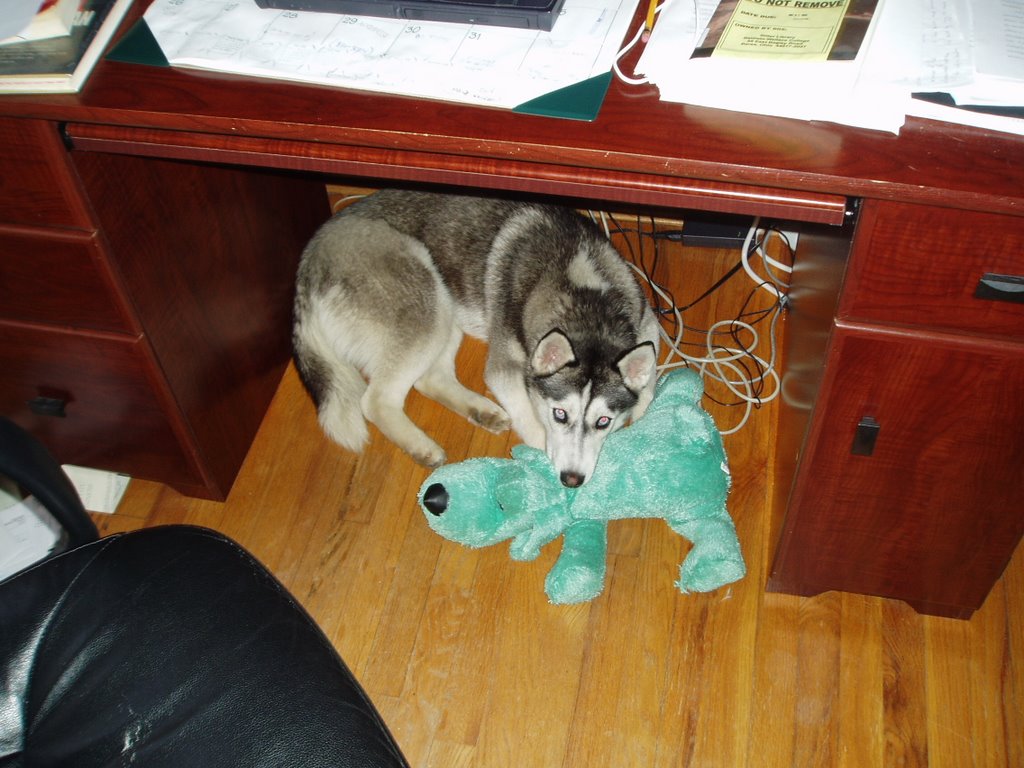
  • And last, don't let her innocent appearance fool you, my dog is a badass. Yesterday the wife & I were invited to bring her along to a cookout. Things were going fine for about fifteen minutes. There are about four or five other dogs. Ireland was bouncing around and having a good time running after balls & trying to steal sips of beer, when suddenly she & a dachshund named Dandy caught scent of a wild rabbit in the yard. They both went on the hunt, but only Ireland emerged with the prey. Blood on her snout & teeth, Ireland paraded through the circle of guests and around the firepit with the poor animal dangling from her jaws. As I chased her down, I heard the screams of children & adults alike, 'That poor bunny!!!', and sternly tried to dissuade this newly feral beast from shaking the rabbit any further, as the fur was beginning to fly dangerously in the direction of the food. I finally got the dead rabbit from her, despite her token growls & cries of protest, and the bunny was flung in the front yard for the family to deal with later. The last time she caught her intended prey (the only other time), it was a bird at the park, and it took about a week for her swelling pride to diminish to a nearly manageable level. Until then, she will race with all the vim & vigor her newfound bloodlust can manage toward every bird & squirrel downtown. It should be a fun week.

  • Oh, I almost forgot. Barring something unforeseen, namely me getting one of the jobs I've applied for, I'm going to be moving to San Francisco sometime late next month.
  • The Collect

    Heads up all in-town readers, a good friend of mine is organizing an art exhibition that you are invited to help with. Don't worry, it doesn't involve public nudity or bodypaint. Just your trash. And so the new wave of recycling begins. Be the first on board.

    Monday, March 05, 2007

    'Take What You Need'

    Last night I was talking to a friend and he told me about a church service he'd recently heard about. Just after a sermon about giving & receiving, the preacher had the offering buckets distributed throughout the congregation/audience and told everyone in attendance to 'take what you need'. When the buckets returned to the stage, there was still money in them. So, he proceeded to exhort them all the more to take the money, and if they didn't he would shread it at all (as he did with a few bills). The upshot of all this was to tell them about how the church's benevolence ministry is there to help people out when they've fallen on hard times.

    Okay, so here's my question, is this a good lesson? I'll confess that I'm pretty ambivalent about it. On one level, sure, this is all well and good. They're sharing money with one another, etc. I get that. But my initial, and stronger, reaction is more negative. I'm just not entirely sure why. Part of the reason is that I know the Sunday services of this particular church are (or at least used to be -- no clue about how things are now) 'seeker-oriented', and thus not intended to be a full manifestation of their fellowship & teaching. If that is the still the case, this just seems really flashy to me, and possibly (though I'll hold off from assessing their intentions here) a little disingenuous.

    Also, just what exactly did he mean by 'take what you need?' Now, my friend wasn't at this church, and he couldn't be sure what the minister's exact words were, but they had to be something like this. He wouldn't say, 'Take what you want', would he? And if he did, well, there'd be no ambivalence about this at all -- I'd be thoroughly against it, but still very keen on attending the next time I saw he was preaching on the subject. But 'take what you need'? I think I'm pretty representative of a lot people's financial burden's -- even with my catastrophic student loan debt, since the value of most people's houses are bound to go belly-up in a few decades and explode the assumption of their long-term investment value -- and my 'need' would surely go beyond what I would be expected to take out of a church offering bucket. I could dig in there until I pulled out enough for rent & utilities, or whatever amount would actually put K. & me in above zero each month, but if I did so, oh dear, the IHOP would be abuzz with snickers & gasps about 'that greedy guy who took over a grand!' (None of this even addresses that one's financial need might be brought about because somebody just bought a new boat that's really straining their budget, or that gas-guzzling SUV parked out in the church parking lot, or the superfluous education one sought for the sake of getting a job that'll let him have summer's off -- not out of a real lack.)

    And the heavy-handedness of cutting up money? Is the point of this to situate the reception of a church's benevolence alongside the (evangelical) Christian message that one accepts ('receives' even) Jesus as savior not simply because he loved us first but because of the content of that love -- because he was broken, beaten & killed for our guilt as sinners? Is the reception of this grace and the reception of financial stability so close?

    And yet, as I say, I'm open to the potentially positive aspects of this object lesson. I'm ambivalent, though obviously not the insidious brand of ambivalence that sees a 50/50 split between the good and the bad. What about you? I'm genuinely curious what many of you make of all this.

    Saturday, February 17, 2007

    Do Not Adjust Your Dial

    As you no doubt have already noticed -- and I'm sure at least a few of you hit the back button, thinking you for sure typed in the wrong address -- but Silentio looks a little different. Short version: I was fiddling with Blogger today, and ended up not only changing the template (the only one this blog has ever known) but accidentally deleting it. As good a time as any for tidying up. Things are still in-process here. I've not yet decided what I want to add. Suggestions are welcome.

    An interesting thing I long suspected but never knew for sure: over half of my blogging production was done in the first year of this site's existence. In the second month alone I crammed out 84 posts. To put that in perspective, I managed only a combined 90 posts during 2005 and 2006.

    Thursday, February 08, 2007

    Ahead of His Time

    John Ruskin, of course, didn't live to see the modern-day horror that is suburbia, but he described it better than most:

    I look upon those pitiful concretions of lime and clay which spring up, in mildewed forwardness, out of the kneaded fields about our capital -- upon those thing, tottering, foundationless shells of splintered wood and imitated stone -- upon those gloomy rows of formalized minuteness, alike without difference and without fellowship, as solitary as similar -- not merely with the careless disgust of an offended eye, not merely with sorrow, for a desecreted landscape, but with a painful foreboding that the roots of our national greatness must be deeply cankered when they are thus loosely struck in their native ground.

    Sunday, February 04, 2007

    A Nauseating Display

    This is a bit premature, maybe, what w/ the Bears down by only twelve with enough time to score twice, but I think I can go out on a limb here and say that this is one of the most embarassing offensive displays I've ever watched. Seriously, the Bears as a team & as a legion of fans would have been much better off if they'd lost to the Saints in the NFC Championship. People would've been disappointed, sure. But, this, this has been a debacle!

    BTW ... cast your MVP vote for Rex Grossman at NFL.com before the game is over. Because surely he's done more for the Colts than anybody else!

    Oh, and congrats to the Colts. In a few minutes you'll be the answer to the trivia question that baffles millions in a few months, "Who won the Superbowl last season?" Soak it up.

    Update: Manning is the MVP??? Um. How about the Colts whole offensive line? More possibly, I suppose, what about Dominic Rhodes? Even more possibly, if Dungy hand't inexplicably yanked him in the third quarter, what about Joseph Addai? Seriously, this is yet further evidence to just skip the Superbowl from here on out.

    Thursday, February 01, 2007

    Here I Come!

    I have a pretty active imagination, but never so much as when I'm walking through town with my headphones on. I love setting the IPod to shuffle and seeing what the soundtrack to my stroll will be today. After all, all of life's moments need a soundtrack. From sleeping, to sex, to cooking, to fights with the wife. Today's was perfect: The Roots's "Here I Come." I couldn't find a streamable MP3 I could directly link to, but this video of their appearance on Letterman is kickass enough for you to get the idea.


    If you can't get your strut on to that, you simply never will. And if you don't have a strut in my neighborhood, well, there's gonna be a problem.

    Friday, January 26, 2007

    For Julia

    There are so many reasons to hate Duke University's basketball team. I could devote a blog to them, in fact. But, the end of last night's Clemson game says enough.


    Thursday, January 25, 2007

    Solitude

    This may sound at first like a contradiction, but the greatest thing thus far about my urban life is the solitude it offers. I should explain, since "solitary" is not, by default, a good thing to most people. A solitary life, in my estimation, is most possible only when one is amongst other people. One can live in solitude next to a loving partner in a happy relationship, as well as when surrounded by neighbors in a community you are happy to call your own -- even when neither the relationship or community are necessarily perfect. For indeed solitude is, at root, a celebration of this fragility, an attunement and attention not to what is lacking in these relationships and communities, to their existence in some perfect state, but to one's place in the midst of their reality, in all its fragility. In fact, it might be that much more difficult, impossible even, to achieve solitude in a horrible relationship and community, for in these one's attention tends to be drawn effortlessly to its deficiencies, and thus to what might fix it. It is this culture of remedy, of self-help and cures, of redemption from weakness rather than redemption of weakness, that is really the culture of isolation -- isolation from the reality that people are, well, people.

    Solitude is a form of self-consciousness borne of self-reflection. Too commonly, self-reflection is thought to mean isolation. This is a lie. When one looks in a mirror, one sees something. But this something that we call a "a reflection of me," is only understood as such if we are a part of something far greater than ourselves: a community of others, of other "me's," through whom I can identify myself as "me" and them as "not-me". And people are, if anything, weak-kneed versions of themselves -- even when playing the hero -- of all that they aspire to be, of their confessions and ideals . We, in short, tell the truth when we lie, for in falsehoold are we finally being ourselves; and we lie most tellingly, betraying ourselves most fully without even the benefit of thirty pieces of gold, when we unsuccessfully try to tell the truth about ourselves. It's not that we don't know this truth -- oh, we're well beyond self-discovery and finding ourselves, but two of the self-perpetuated frauds that expose much more truth about ourselves than we'd like to admit.

    Solitude draws one's attention to this because it is an intentional living, and thus a life truly lived; one lived aware of oneself as being amongst others who are different creatures, with their different stories, joys and heartbreaks, but all bearing the same weight of his or her creaturely life. It is an attunement to a harmonious dischord. Listen to life in the city, open all your senses to its voice -- for it is a voice that can be seen, touched, and smelled -- and you cannot miss this atonal horror that we can't do without. Such is the beauty, or is it the sublime, we can't stand most of the time, that often repulses and angers us, but that is the torturously cruel heart of life's mad melancholy -- which is to say, this life's capacity to create itself anew.

    Don't get me wrong. I'm not saying that urban living has exclusive rights to solitude and creativity. Madness. Rural life may be immediately pastoral, with its dumb simplicity and splendor, sunrises and sunsets, but I am certain that the one with the ear to hear knows better. To see beyond the apparent, we need only watch movies like Fargo, read novels like In Cold Blood or anything by Cormac McCarthy or Flannery O'Connor, or talk to my friend Brad P. about the social injustices & reality of rural poverty. No, solitude, the pulse of imagination and anything resembling hope, is beyond the simple divisions of urban & rural, a fact exposed (ironically) by the the masquerade of solitude in that mediated space between rural & urban, the neither/nor, the medicated isolation of our communities of the car and suburban kingdoms.

    More on this false solitude, a solitude that is a betrayal of itself, this "geography of nowhere" (as described by James Kunstler), later.

    Monday, January 22, 2007

    The Road to Nowhere

    Figured I should show some love to my thoughts on Cormac McCarthy's new book, The Road. If nothing else, it deserves a link somewhere. Readers, however, are a different story altogether.

    Stay tuned for a more substantial post. Should be up later Monday.

    Friday, January 19, 2007

    A Day in the Life

    So, it seems the wife & I have survived almost nine full months in the heart of darkness, the belly of the beast, the kernel of the corn – living in the riot-scarred ghetto of Cincinnati. It has been, for lack of a more banal word, interesting. The things I thought I’d hate, or at least fear, do not even register on a daily basis; and the things that I would not have even thought about prior to the move bug me daily.

    Most naturally, I suppose, I went in fairly concerned about safety. This has, thus far, turned out to be a non-issue. Granted, much of this might have been due to the police crackdown in the neighborhood following the April 2006 murder spree; or, more plausibly, it had to do with the fact that neither K. nor I buy or sell drugs, and thus aren’t worth the bullet or bludgeon of a would-be assailant. I like to tell myself that my homeless guardian crack addict played some small role, too – the very one who promised me evening that he would “kill” (his words) anybody who disrespected me, K., or “my little girl” (his designation for the dog). I don’t know about you, but I’ll gladly support somebody’s crack addiction with a dollar here and there if they promise me protection.

    Speaking of crack addiction, I’m increasingly astonished at how many functional addicts there are. I knew that there one could actually live some semblance of a life addicted to heroin, alcohol, and cocaine, but for some reason I thought that with crack all bets were off. My suspicion was that what distinguished crack addiction from all the others listed is that it is primarily the poor addicted to it -- and, if nothing else, money buys functionality, whether you’re an addict or sober. Not yet sure what to think of this.

    Less shocking, I suppose, is that our car has not been broken into. It helps that our little Honda is twenty years old and that I’ve wrecked it at least twice; not to mention the fact that we heeded the warning of a neighbor, who once noted that he had a roll of paper towels stolen from his car once, and have since left nothing but philosophy books in the back seat. Thus far, the only minor vandalism inflicted was that our antenna was unduly ripped off. I can deal with that, provided somebody isn’t whipping me with the antenna removed.

    What has been an issue – no, the issue is the litter. I used to drive through this neighborhood all the time before living here, but seeing trash when at 30 mph is not the same as when you’re wading through it on the way home. Condoms, used or not; paper plates with pizza crust; chicken bones (it is as though my neighborhood is a fucking hen house and a fox is on the loose); piles of glass, be it that of car windows or liquor bottles. I really should just keep a daily tally of the different things I have to wrestle away from the dog. I’ll have more to say about this in coming posts, though, especially as it relates to the across-the board-decline and neglect of the living space in contemporary America (be it rural, suburban, or urban). For now, suffice it to say, a trashed environment is indicative of a deeper problem that is not endemic to ghetto life.

    All in all, life hasn’t been so bad down here. I miss the two-minute walk to the only art-house theatre in town, as well as the only grocery with a decent beer & cheese selection. I miss the sense of security (which is different from the reality of safety) that I felt walking late at night in the relatively affluent neighborhood I used to live. Don't get me wrong, I’m not a martyr for moving away from all that. But, as I'll explore in my next post, I do think it was the right choice to move down here, even if I often regret the decision to do so. There are deeper implications to this admission, but it’s way too late to get into them.

    Wednesday, January 17, 2007

    Don't Worry, I Lit a Match

    My dearest friends, approximately three months ago, on October 12, 2006, to be precise, I presented you with evidence of the existence of God. Since then, as you can well imagine, there has been a lot of soul searching here at Silentio Central. Thus the three-month silence. As one reared in the bosom and by the stern hand of evangelical Christianity, who subsequently stole away from the faith in the deepest of nights, pitch black, in fact, what for the clouds of doubt covering all semblance of light, this revelation came as, not a shock, but as the nauseating onset of something nearly indescribable, something only viewed in a small room with the door closed. Too much truth, like too much starchy food, especially curry, fell upon me, and I was overwhelmed. My cup overfilleth, indeed, and the excess left me feeling, well, a little bloated.

    Oh! But fear not. It took repeated probing, but I have, only today, realized that this Lord of the Arse was not due the undying fealty I dealt it. I should say that this was not due to his inadequacy, nor to the fact that this divine sign was filled with only poo. No, this vision of a poop-chute Jesus rising to the heavens made me realize that the Lord was always to be behind me, heard but never seen; or, if seen, seen only in my wake, in what I leave behind for others; or, barring that, in a one-time visit to a website about a dog’s anus that bears a striking resemblance to our popular imaginative rendering of a biblical scene. What I realized, after much strain whilst sitting, a posture due the longest, most pleasurable but often most foul, of thoughts, was that if blind devotion is not due the Lord, it makes him no less Lord. I realized, rather, that he is created, in a series of movements, of my movements, of your movements, of our movements. All together, we squeeze together a fashioning of the Lord, and we leave a prize for others to find! A nugget of ourselves that, upon its exit, is no longer ours, for it is no longer distinguishable from all the others. Sometimes we leave a larger piece, sometimes only a trace – but it is always there. And every bit is but a whiff of the Spirit.

    All this is to say, I realized it was foolish to hold it in! To make myself silent is to make myself deadly to the world. Let it rip, I said, these acts of God. I must blog, I said aloud. For to blog is divine!

    Pull my finger, and it shall begin anew.